Digital trade rules are privacy, safety and accountability-driven and have differential compliance costs. This study calculates the impact of the changes in market access, investment, seller participation and competition for small firms due to data localization, platform liability, and cross-border compliance. A calibrated causal benchmark design brings together quasi-experimental estimates of the impacts of regulatory shocks, and panel evidence on digital trade restrictions and structural platform-liability models. Compliance shocks have been found to impact on the number of venture deals, the amount of funding, website traffic, revenue and the number of technology vendors, for newer, data-driven, consumer-oriented and early-stage companies. The cross-border transfer rules and the regulatory heterogeneity have the biggest negative impacts on data-flow restrictions. Platform liability enhances auditing in low seller recovery but it restrains seller entry and innovation in platform power. Interoperable transfer standards, centralized screening and screening thresholds, proportionate thresholds, and one-stop compliance replace multiple localization and duplicative reporting. Coordination is what will benefit the users, but will not give the incumbent a size advantage based on jurisdictional diversity.
Research ArticleDigital Trade RegulationIn progress
Digital Trade Without Regulatory Arbitrage: Causal Effects of Data Localization, Platform Liability, and Cross-Border Compliance on Smaller Firms
Correspondence: asifjawad4567@gmail.com
Abstract
Keywords Digital TradeData LocalizationPlatform LiabilityRegulatory ComplianceSmall FirmsRegulatory Arbitrage
1. Introduction
Digital trade has transformed the way international trade is conducted from goods-based to ongoing streams of data, software, logistics, payments, IP rights, and platform intermediation. These transactions are often not included in one of the territorial rulebooks. Similar to the individual, a small exporter selling via an online marketplace might be subject to privacy law in the selling jurisdiction, localization or transfer conditions in the data hosting jurisdiction, product and intermediary liability in the selling jurisdiction, and customs reporting at the border (Burri, 2023). Trade law has adapted to the digital world, the data-flow commitments and provisions on electronic commerce, but the reality of the cost of serving foreign customers remains with domestic law. This interdependence is enhanced by the increasing importance of AI and cloud computing and algorithmic matching in cross-border production. Digital trade policy is thus a topic that brings together digital market openness, consumer protection, industrial policy and regulatory sovereignty (Cumming et al., 2023).
It's not that there's no regulation; it's that it's not being felt. Digital platforms lower search and contracting costs, as well as geographic entry barriers, and increase international expansion beyond traditional multinational companies (MNCs) (Meyer et al., 2023; Stallkamp & Schotter, 2021). These systems of payment, access to foreign markets, outsourced capabilities, and reputation are too costly for micro, small, and medium-sized enterprises to establish on their own (Elia et al., 2021; Hervé et al., 2020). The gains are dependent on the capacity of the organization. The obstacles of cross-border e-commerce limit the performance of online export (Eduardsen et al., 2023), and the digital infrastructure and connectivity to the foreign market change the gravity of the loss. Smaller companies typically have smaller margins, fewer legal staff, less leverage over cloud/ platform vendors, and less ability to replicate technology systems in different jurisdictions. Being forced to perform a fixed regulatory function uses more of their managerial and financial capacities and resources than performing the same function does for an incumbent firm.
Three regulatory instruments have different, but related channels. Either local storage, local processing or specific conditions of transferring data are necessary to comply with data localization. These rules reduce access to efficient data services and hinder productivity in data-intensive industries (Ferracane et al., 2020) and imports of digitally delivered services, if the restrictions are directed towards cross-border data transfers (Van Der Marel & Ferracane, 2021). Cross-border compliance is not limited to localization but also comes into play in the field of consent management, transfer assessments, cyber security documentation, tax registration, customs data, product certification and destination-specific reporting. Differentiated, highly digital, and high-technology products are the most impacted by country data restrictions in the importer country when it comes to cross-border exports of e-services (Ma et al., 2024). The term platform liability is used to shift the liability to third party activity that is unsafe, illegal, infringing or defective. Software that passes the fees through to the seller, documentation requirements, and conservative delisting also impact seller participation, as does centralized liability.
The most obvious causal findings are related to privacy compliance. The adoption of the European Union's General Data Protection Regulation (GDPR) dampened the amount of venture funding that went to European tech companies compared with other markets, especially the newer, data-oriented, consumer-oriented and early-stage companies (Jia et al., 2021). Even for online companies, there has been a drop in the number of visitors to their websites and also in their earnings due to the regulatory modification (Goldberg et al., 2024). Technologies from vendors used on the website decreased in terms of the supply-chain, and reduced competition among the remaining vendors (Johnson et al., 2023). The results show an even more common asymmetry: a rule formulated without a small-firm carve-out may be able to enhance the scale benefits, given the implementation of compliance technology, legal skills, and diverse revenue streams. There's another asymmetry added to platform liability models. When selling firms have weak assets, residual platform responsibility enhances auditing, but optimal liability requires platform effort being observable and harm being internalized and user consent (Hua & Spier, 2025).
The body of existing literature is split into different fields related to trade economics, international business, information systems, industrial organization and law. In general, data-localization studies tend to measure the sectoral impact or productivity gains without broken down by incidence by firm size. To date, privacy studies have provided robust quasi-experimental estimates and are concerned exclusively with a single regulatory regime. Platform-liability research, while detecting welfare mechanisms, does not usually explain the connection between welfare mechanisms and the entry of smaller firms or the costs imposed by sellers across the borders, or the regulatory variation within a single mechanism. Barriers are described in cross sectional SME studies, but do not focus on regulatory shocks. Therefore, much policy discussion focuses on the benefits to consumers of consumer protection against the aggregated costs of trade, which is left unspecified.
This work fills that void, estimating the effects of the three regulatory pillars on market access for smaller firms, and pinpointing designs that can lead to a reduction in regulatory arbitrage, but not the entrenchment of incumbent firms. Four hypotheses are used to analyse. H1 believes that data-location and data-transfer policies have a negative impact on cross-border participation, as they lead to duplicated infrastructure and the loss of efficiencies in the use of data services. H2 believes that the costs of compliance are higher for newer, data-dependent, consumer-oriented, and less mature businesses. When sellers are not very good at recovering the liability, H3 anticipates that platform liability will enhance auditing, but limit entry and innovation when concentrated platforms shift large compliance expenses to sellers. H4 foresees that interoperable transfers, central screening, thresholds that are proportionate, and one-stop reporting will result in a better protection-burden ratio. The contribution is an integrated causal benchmark which disentangles the effects of regulations and liability outcomes from a model, maintains firm heterogeneity, and renders the coordination of regulation into testable market-design propositions.
2. Literature Review
2.1 Digital platforms, internationalization, and the liability of smallness
Digital commerce alters the order and expense in internationalization. Platforms are a central hub for demand, payment, trust, fulfilment services, and market information, whilst simultaneously allowing businesses to connect with foreign customers without having to form traditional affiliates (Hervé et al., 2020; Stallkamp & Schotter, 2021). Resource-based accounts relate the extent to which digital exports take place to technological capability, specialized management, and coordination of the online channels. But barrier research indicates that organizational exposure combined with external infrastructure is what really impacts exports (Eduardsen et al., 2023). Platforms thus reduce the costs of entry into the market, but also create a reliance on private controls and ranking systems, commissions, data access, and verification systems.
The latest international business studies place the digital strategy in the framework of the national institutional differences, and not beyond them (Meyer et al., 2023). Smaller companies can take advantage of having established a presence in the marketplace and e-marketing tools (Elia et al., 2021; Hervé et al., 2020) but platform dependence reduces their bargaining clout in allocating regulatory costs. Trust and outsourcing expenses for the smallest businesses are also cut by Digital work platforms (Eduardsen et al., 2023). The literature is concordant that intermediation lessens resource constraints; the majority of the literature is based on survey designs and a few on case designs. Public regulations that enable access to platforms and gatekeeping do not usually measure the effects of these changes on the value of platform access, and for this reason there is no common estimand for entry-enabling and gatekeeping effects. This onboarding, verification, and data-access delay costs matter because regulatory costs may be passed on as a delay for the onboarding process, verification process or data access.
2.2 Data localization, transfer restrictions, and productive fragmentation
Data localization works in several ways, including: storing data in multiple locations, splitting up data processing, replacing suppliers, and preventing access to cross-border analytics. At the firm- and industry-level, tighter data policies are linked with reduced productivity levels of firms engaged in the downstream data-intensive sector (Ferracane et al., 2020). The largest negative association is the one between trade and cross-border transfer restrictions, as reported in trade estimates (Van Der Marel & Ferracane, 2021). But restrictions in importing countries reduce the exports of cross border e-commerce, especially for differentiated, digitally-intensive and high-technology goods (Ma et al., 2024). In addition, manufacturing exports are also hampered by data-enabled services as intermediate inputs, and barriers to digital services. Furthermore, different regulations in both sides of the border and data-enabled services as intermediate goods are barriers to manufacturing exports (Yang et al., 2024).
There are conflicting views in the literature regarding the gains of domestic providers. Dispersed concentrations could shift demand to local services, but these are counter balanced by an increase in difficulty of finding suppliers and by a decrease in scale economies. The value-chain research tackles the linkage between cross-border restrictions and reduced production stability (Yang et al., 2024). The adverse outcomes of information infrastructure and institutional quality are found to be mitigated by studies on export efficiency and financial services (Y. Li & Zhu, 2024; Zhang et al., 2025). The question of whether or not a system is open or closed is not the most important factor, however, when considering regulatory quality and interoperability. However, in most specifications, the cost of smaller exporters is not specified it is included in country-sector panels. Another difficulty in interpreting the welfare effects of the size of the firms is that there are no interaction terms with firm size.
2.3 Cross-border privacy compliance and market structure
The best quasi-experimental environment for cross-border compliance is that provided by privacy regulation. After GDPR enforcement, venture estimates indicate a reduction in both the numbers of European ventures that are formed as well as the intensity of financing (Jia et al., 2021) especially for data-intensive, consumer-oriented and more recent ventures. Estimates based on website traffic show less traffic and less revenue (Goldberg et al., 2024). Technology-stack analysis accounts for fewer numbers of vendors of web-services, and a greater concentration of suppliers (Johnson et al., 2023) and spillover research captures adjustments outside of the directly regulated territory (Peukert et al., 2022). The results from mobile apps reveal a variety of adaptation, with higher relative positions for stronger foreign adaptations (Z. Li et al., 2025).
Reduced data collection and information value (across publishers, advertisers and intermediaries) is incurred with tracking and advertising research (Aridor et al., 2023). The idea that there is none and that privacy is not valuable is not the common argument, but rather implementation modifications the market structure by fixed costs, availability of data, vendor consolidation, and investor expectations. There is mixed evidence on the rate of adaptation. Some operating results bounce back, while some capital formation and concentration continue. Small-firm exposure identified by venture age, financing stage, data reliance, and customer orientation are smaller than what is shown. Frequent exposure categories of direct employment size categories are uncommon, though there are smaller exposures identified by venture age, financing stage, data reliance, and customer orientation. Some existing research also discusses limited attention to substitution of a specialized foreign vendor by a larger approved foreign vendor (cross-border supplier substitution.
2.4 Platform liability, monitoring, and seller participation
With harmful sellers lacking assets and incentives to compensate users, platform liability comes into play. From a structural perspective, it has been demonstrated that there is an increase in interaction prices and auditing when sellers are limited liability, due to platform liability (Hua & Spier, 2025). Innovation models include network effects, which affect the direction of the changes in commission rates, screening, imitator activity, innovator entry and welfare, depending on the participation elasticities and the relationship to the networks (Jeon et al., 2026). The allocation of liability also relies on who is monitoring the efforts of safety and who is designing the transaction. There are significant differences across jurisdictions in terms of exposure to the marketplace (Kim, 2024).
Platforms with superior information and control leads to better enforcement with centralized responsibility. The contradiction is on over-removal. Safely attaining liability encourages screening, but impenetrable screening or total fee pass-through is detrimental to the marginal legal seller. Empirical platform entry research reveals that expansion of a platform is of benefit for the high-quality firms, but not for the low-quality firms (Jeon et al., 2026). Platforms have also been found to take away more than a sales channel from the list of small enterprises excluded from the market (Eduardsen et al., 2023) because they also diminish trust and outsourcing expenses. Despite some new direct estimates of the liability reform impact on cross-border small sellers, identification of the impact within a structural model is still crucial but needs to be separated from observed data. Another not yet addressed issue is the quality of the appeals, which could drive up the quality of cases through initial screening, while poor reinstatement practices would result in lasting damages to those who are lawfully removed.
2.5 Integrated gap and causal propositions
The streams reviewed meet up at a single cost mechanism, but use different margins. The trade and productivity aspects of data-policy studies, the investment, traffic, revenue, and supplier concentration aspects of privacy studies, and the aspects of auditing, price, entry, and innovation of platform models are all emphasized. Fragmentation is already covered by legal scholarship maps, as is capability constraints by SME research (Meyer et al., 2023). No framework documents the interaction between the three conditions for the participation of smaller firms localization, liability, destination-specific compliance.
There is no direct pooling due to methodological fragmentation. There are no common scales for percentage changes, semi-elasticities, ordinal legal classifications or results of structural welfare. In a valid synthesis, a separate class of estimand for every type of regulatory shock is required as well as a separate class of estimand for every type of panel-based directional restriction and a separate class of estimand for every type of model-implied liability regime. The dilemma is whether that will be achieved by a fragmented approach or through coordinating different designs to maintain protection and decrease destination-specific, fixed tasks. This gap drives a calibrated benchmark that will keep the source identification, harmonize only comparable outcomes and will test interoperability and centralized compliance as market-design alternatives. Integration of the question is thus related to who does compliance, who pays for it, whether it can be reused and how this influences the entry barrier by firm size.
3. Conceptual and Theoretical Framework
The study follows an integrated framework of fixed costs and platform-governance, which is based on three premises. Firstly, the differences in the impact of the same obligations on firms is due to the different kinds of regulatory absorption. A firm needs to enter into a foreign digital market if the fixed costs of compliance with the market, the transaction costs involved in the market, and platform fees are less than the operating surplus expected by the firm. Due to their limited legal, technical, financial and managerial capabilities, data localisation and geolocation requirements in terms of privacy, taxation, certification, customs and reporting increase the market entry barrier in smaller companies.
Second, delegated platform enforcement looks at the behavior of smaller sellers when there is liability allocation. Second, delegated platform enforcement examines how liability allocation affects the behavior of smaller sellers. Platforms are responsible for the verification, payments, rankings, listings, data regarding transactions, and removal. Residual liability is a way to enhance auditing in situations where harmful sellers do not have assets to be recovered (Hua & Spier, 2025). But centralized verification will be more costly and lead to more instances of noncompliance, while fee pass-through, over-precaution, and opaque delisting will result in more seller exclusion. These effects are more pronounced if network effects are lessened in other ways of accessing the market (Jeon et al., 2026). Platforms do provide smaller companies with a reduction in resource constraints (Gusenbauer et al., 2025), but there are uneven benefits for the sellers (Reshef, 2023).
Third, compliance costs are spread out across markets by large corporations, which set up entities in local markets and negotiate for localised infrastructure, while small corporations incur mostly non-divisible compliance costs in the local market. These fixed tasks will not be undermined by interoperability, mutual recognition, standardized interfaces and one-stop reporting. Figure 1 brings together these mechanisms and connects regulatory design and compliance costs, platform auditing, market entry, financing, survival, innovation and concentration.
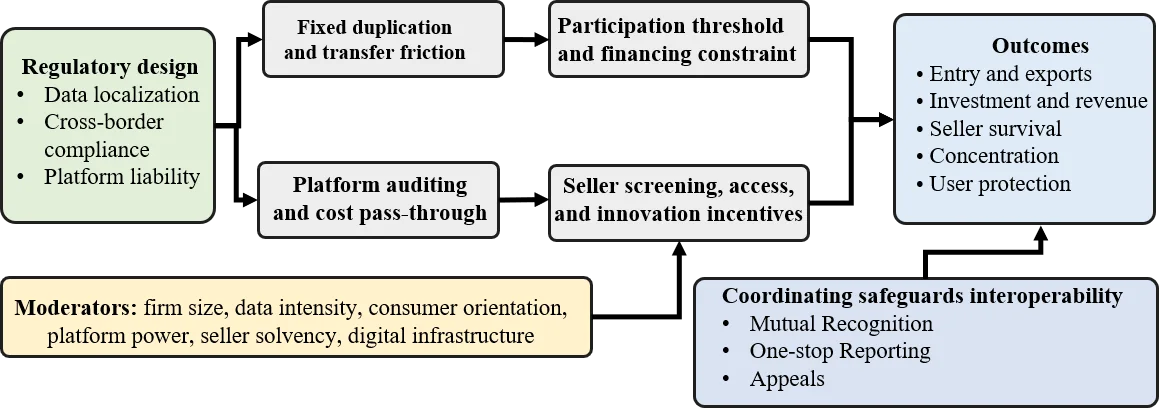
The framework is expected to result in negative localization and fragmentation effects, a conditional liability effect, and better results in the case of coordinated compliance. These relationships are moderated by firm size, data intensity, power of platforms, solvency of sellers, orientation of the consumer, and digital infrastructure. The assessment of regulatory welfare is based on the protection, participation, and structure of competition. The framework is then in terms of hypotheses, their treatments, outcomes, analytical components, and decision criteria as summarized in Table 1.
Table 1. Hypotheses, estimands, and decision criteria
| Hypothesis | Regulatory treatment | Principal outcomes | Analytical component | Decision criterion |
|---|---|---|---|---|
| H1 | Localization and transfer restriction | Cross-border participation; services trade; productivity | Directional panel synthesis | Support when restrictive cross-border channels dominate domestic-use channels |
| H2 | Fragmented compliance shock | Venture deals; funding; traffic; revenue; supplier use | Quasi-experimental estimates and subgroup contrasts | Support when losses concentrate among newer, data-reliant, consumer-facing, early-stage firms |
| H3 | Platform liability allocation | Auditing; seller entry; innovation; welfare | Structural directional counterfactual | Support when auditing improves under weak recovery but entry and innovation fall under platform power and pass-through |
| H4 | Coordinated compliance design | Protection score and smaller-firm burden | Calibrated policy frontier and robustness checks | Support when interoperable, centralized, and one-stop designs dominate fragmented alternatives |
4. Methodology
4.1 Research Design
A three analytically distinct calibrated causal benchmark design was used in the study. The quasi-experimental regulatory shocks included measures of the percentage change in venture investment, number of website visitors, revenue, website vendor use, and concentration. Data-policy restrictions estimated by panel were found to have directional impacts on services imports, productivity, cross-border e-commerce, manufacturing exports, and innovation. There were conditional predictions provided by formal platform-liability models covering the four areas of auditing, seller entry, innovation and welfare. These components were analysed separately to avoid being misled by structural predictions as observed treatment effects. The regulatory-treatment–outcome estimand was the analytical unit used to conclude, and those conclusions were drawn, not based on the average of the regulatory and market settings.
4.2 Study Area and Sources
The study area was cross-border digital markets in jurisdictions with data-localization rules, platform-liability rules, and destination-specific compliance rules. The quantitative sources were included if they determined there was a regulatory treatment, digital-trade outcome and credible comparison group, fixed-effects model, instrumental-variable strategy or structural equilibrium. The observed-shock dataset observed changes in the number of firms, ventures, websites, apps, vendors, revenue and concentration. The restriction dataset included policy type, the direction of the outcome, the policy strength, the degree of policy heterogeneity, and the policy mechanism; the platform dataset included answers to the questions regarding (1) whether the platform was sold at solvency, (2) whether it was auditable, (3) whether it was of strong or weak network, (4) whether it was powerful or not, and (5) whether liability was allocated to the platform. Other outcomes that were not related to smaller-firm participation or with cross-border production were not included in the final analytical calibration.
4.3 Estimate extraction and harmonization
Percentages were not transformed as their reporting were found in their reported scale. The coefficients of the log were calculated from the reported ones, when available, by multiplying by 100 and subtracting one from the coefficient of the log. Adverse effects were reported as magnitude of the burden (positivity for comparison) and original directions were left in the source sheet. No averaging of estimates of distinct outcomes were done. If more than one specification resulted in the same outcome the preferred estimate was the baseline or principle robustness specification from the originating study. Any finding that did not have an equivalent publicly available percentage was coded on a four-point directional scale (0 = null or mixed, 1 = weak negative, 2 = statistically negative, and 3 = robust negative) for each of the main specifications. To ensure that the interpretation of the coding is correct, agreement among baseline sign, the pattern of heterogeneity and the robustness statement was required. Disagreements were settled in a conservative fashion with the lowest of the two values being assigned. For all transformations source precision is maintained and no additional digits that were not supported in the source result are added.
4.4 Smaller-firm incidence calibration
The exposure of smaller firms was calibrated based on the observed magnitude of regulatory shocks, rather than the construction of firms' record of shocks. The upper bound for an indivisible compliance and risk reassessment shock was given by the thirty-nine percent decrease in financing for a round. The variable component took as a benchmark the operating-margin reductions of twelve per cent in traffic and revenues. The normative compliance capacity was scaled down by r and the fixed benchmark divided by the square root of the scaled down capacity, and the result was the regulatory burden at fragmentation level r, which was then added to the variable benchmark. Small, medium and large firms had their capacities normalized as being 1, 3 and 10 respectively. The square-root was not a size advantage, but was an expression of decreasing marginal absorptions. The curves are not therefore monetary forecasts for a given jurisdiction, sector or company, but are instead comparative in nature. The values for fragmentation were between 0 and 1, in steps of 0.1, for constructing the charts.
Bₖ(r) = r[39/√Cₖ + 12]
4.5 Platform-liability counterfactual
Normalized directional counterfactuals were used for platform-liability analysis, which were obtained from published equilibrium sign conditions. The four regimes differed on their ability to recover from the sellers, their audits' observability, network effects, platform power, safe harbor design, screening transparency, and fee pass-through. Auditing, Seller entry, Innovation and Welfare were measured from minus three to plus three. If measures improved from seller-only liability then the resulting value was positive, and if measures deteriorated then the resulting value was negative. A result of zero meant that it was an offsetting or indeterminate result. Assignments of the regimes followed the reported inverse relationship between liability and screening incentives, and between commission setting and seller participation, and the positive relationship between seller participation and innovation. Centralized enforcement without full cost transfer was provided by a shared-liability regime that provided a conditional safe harbor and had clear screening. The counterfactual was not designed to estimate damages, sales platform profit, or seller revenue or prevalence. It was designed to be comparative of institutions. Labels for the scenarios were descriptive of institutional conditions and not the individual jurisdiction or platform that might be named.
4.6 Robustness, validity, and research integrity
The changes in robustness testing included changing outcome orientation from fixed cost to median adverse shock, removing one shock at a time, replacing the fixed cost benchmark with the median adverse shock, and recoding weak directional results as null (also a change in capacity elasticity from one-half to one-third and two-thirds). The ranking was unchanged when compliance was fragmented and more burdensome than design was interoperable and small firms had higher rates of incidence than large firms across variants. Construct validity was based on the clear distinction of localization, home use of data, fragmentation of compliance and liability. The statement of the cause of the identification came next, that is, internal validity. Triangulation involved to ensure that the mechanisms were in the same direction in two analytical components. Reproducibility was facilitated by formula linked source tables, visible transformation rules and charts that could be edited. No personal data or confidential company records were used, and no human participation was involved, and the source did not give a numerical value; where only a qualitative direction was given.
5. Results
5.1 Cross-Border Compliance Shock Magnitude
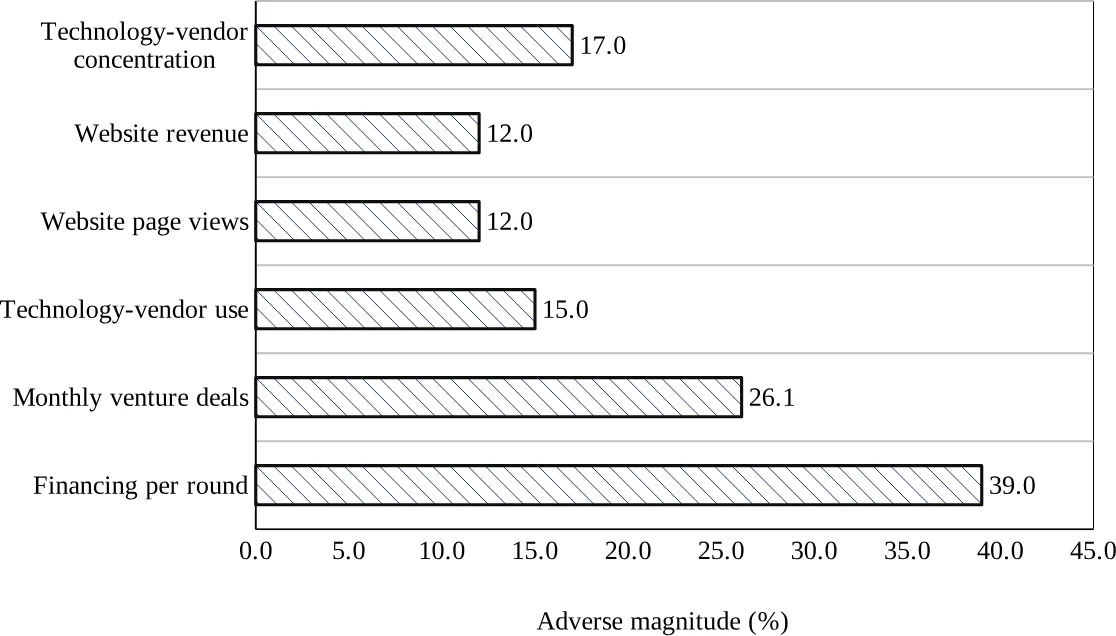
This subsection looks at the changes in markets after a privacy-compliance shock. It sets the boundaries of overall disruption in the financing, digital, revenues, technology procurement, and market structure. The key adverse effects have been plotted on the same percentage scale in Figure 2. The biggest drop is on financing per round at 39.0 per cent, trailed by a 26.1 per cent decrease in monthly venture deals. There's a 15.0 percent decline in technology-vendor use, and the number of website page views and revenue go down by 12.0 percent, respectively. The drop in traffic and revenue is parallel and shows it is not just a technical adjustment, but reflects a drop in the commercial conversion. Concentrating of vendors is also up by 17.0 percent, signifying less diversity of vendors and increased strength for vendors who have proven themselves in the past. The overall impact of the shock is reducing financing, activity and access to external digital services and increased concentration.
5.3 Food Systems and Livelihoods
This subsection compares the regulatory impact across business models, types of data reliance, firm age and financing stage. It is important to note that the comparison is drawn because the estimates of the aggregate obscure that younger and smaller resource firms are exposed to a higher risk. The immediate and subsequent drop in the number of venture deals in eight groups of companies is shown in Figure 3.
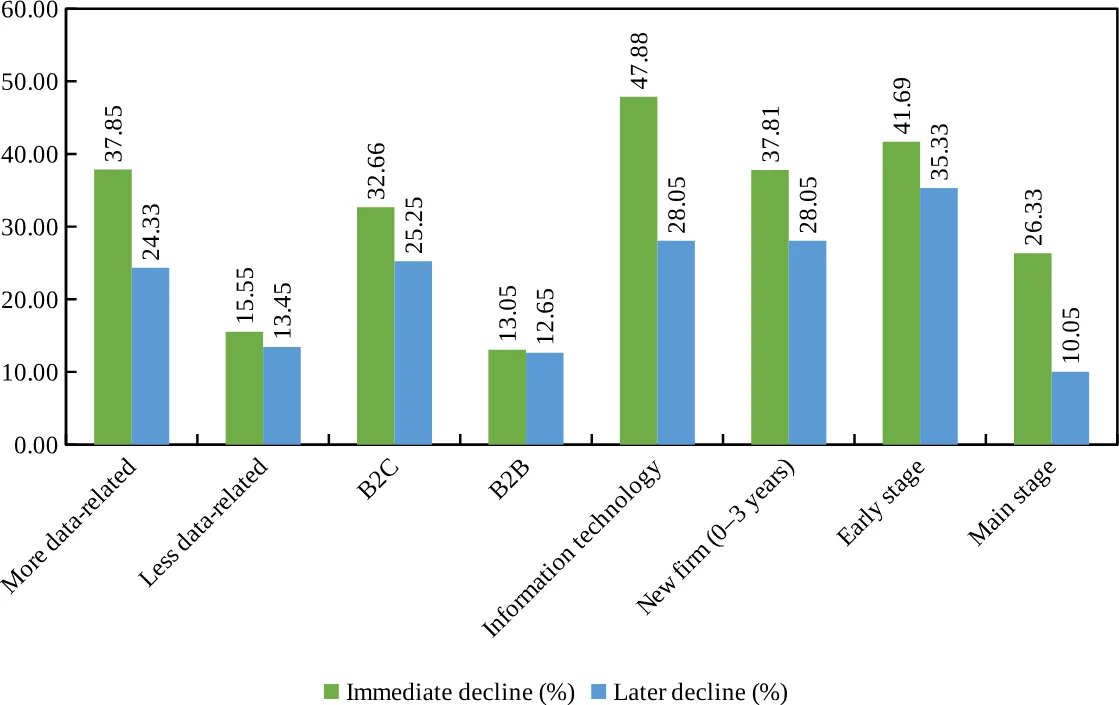
The information-technology ventures had the highest percentage of immediate loss (47.88 percent) and then early-stage ventures (41.69 percent). The data-dependent ventures and firms aged 0–3 years decreased by 37.85 per cent and 37.81 per cent, respectively. The weakest immediate one was seen in business-to-business ventures (13.05 percent). Subsequent estimates are for partial adjustment, but not full recovery. But main-stage companies see their losses slide back to 10.05 percent, while IT, data-intensive, consumer-oriented, new, and early-stage companies continue to suffer losses of more than 24 percent. The remaining 25.28-point difference backs up H2 about data dependence, organizational immaturity, consumer focus, and funding requirements continuing to drive regulatory exposures.
5.3 Data Localization and Regulatory Heterogeneity
The next part discusses the impact of cross-border transfer barriers, domestic data use policies, and regulatory differences on trade, productivity and innovation. Channels need to be identified as they have different administration and production costs. Figure 4 is a map of the direction and intensity of the main regulating relationships. The cross-border transfer restrictions have the highest negative ratings for the imports of digitally delivered services and cross-border exports of digital goods. There are also negative impacts on productivity, manufacturing exports and innovation that are evident. Domestic data-use rules are most directly related to downstream productivity, and have the weakest trade effects. Its worst score is for regulatory heterogeneity, which is indicative of the cost of having to go through procedures on the destination countries. None of the channels result in positive trade and productivity gains. The greatest losses are thus caused by inability to use information internationally and when this information has to be used twice in different jurisdictions, and therefore H1 is supported.
| Services imports | Productivity | CBEC exports | Manufacturing exports | Innovation | |
|---|---|---|---|---|---|
| Cross-border transfer rules | 3 | 2 | 3 | 2 | 2 |
| Domestic data-use rules | 1 | 3 | 2 | 1 | 2 |
| Regulatory heterogeneity | 2 | 1 | 2 | 3 | 1 |
| Digital-services barriers | 2 | 2 | 2 | 3 | 2 |
Figure 4: Heat map of data-policy restriction channels and outcomes
5.4 Platform Liability Regimes
This subsection evaluates the implications of various platforms responsibility allocations for auditing, seller entry, innovation, and welfare effects. The importance of liability design for two reasons: stronger enforcement yields protection benefits while less freedom to remove or screen out sellers results in less freedom for the lawful sellers. A comparison of four structural regimes is made in Table 2.
Table 2. Platform-liability structural regimes
| Regime | Auditing | Seller entry | Innovation | Welfare |
|---|---|---|---|---|
| A: Solvent sellers / observable audit | +2 | -1 | +0 | +2 |
| B: Judgment-proof sellers / observable audit | +3 | -2 | +1 | +2 |
| C: High platform power / hidden audit | +1 | -3 | -3 | -2 |
| D: Shared liability / transparent screening | +2 | -1 | +2 | +3 |
The judgment-proof seller regime has the highest value of the auditing response (+3), but also results in a higher entry loss (−2). The worst combination is hidden auditing, along with a high platform power, both of which rate at −3 for entry and innovation, and at −2 for welfare. The best overall impact is from shared liability that is transparent with innovation at +2, welfare at +3, and an entry reduction that is limited. H3 is supported as outcomes of liability are tied to transparency of the audits, solvency of the sellers, strength of the platforms, and cost pass-through. Increased liabilities hence enhance the enforcement only provided there is transparency in the screening process and there are some regulations controlling the exclusion of sellers.
5.5 Integrated Smaller-Firm Burden
This subsection estimates the different proportions of regulatory compliance capacity that are used by regulatory fragmentation. The importance of the comparison is that the legal requirements are the same, leading to different barriers for market entry among different firm sizes. Figure 5 displays compliance-burden trajectories of small, medium and large businesses.
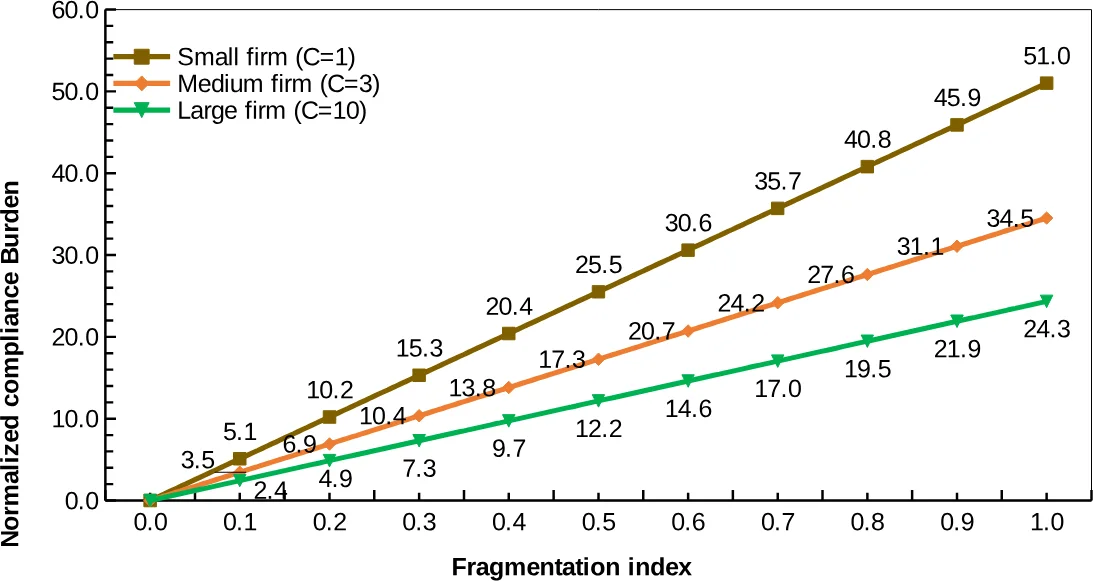
The score of the burden is 51.0 for small firms, 34.5 for medium firms and 24.3 for large firms with a small-to-large ratio of 2.10 at full fragmentation. The values are the same at fragmentation 0.5, at 25.5, 17.3 and 12.2 points. The score of the small–large gap grows from 0 when there is complete interoperability, to 26.7 when the fragmentation is complete. The same rank is observed with alternative parameter choices for capacity elasticities, which is not sensitive to the parameter choice. Even at moderate levels of fragmentation, there is significant disadvantage and less participation for smaller companies.
5.6 Regulatory Design Frontier and Ranking Stability
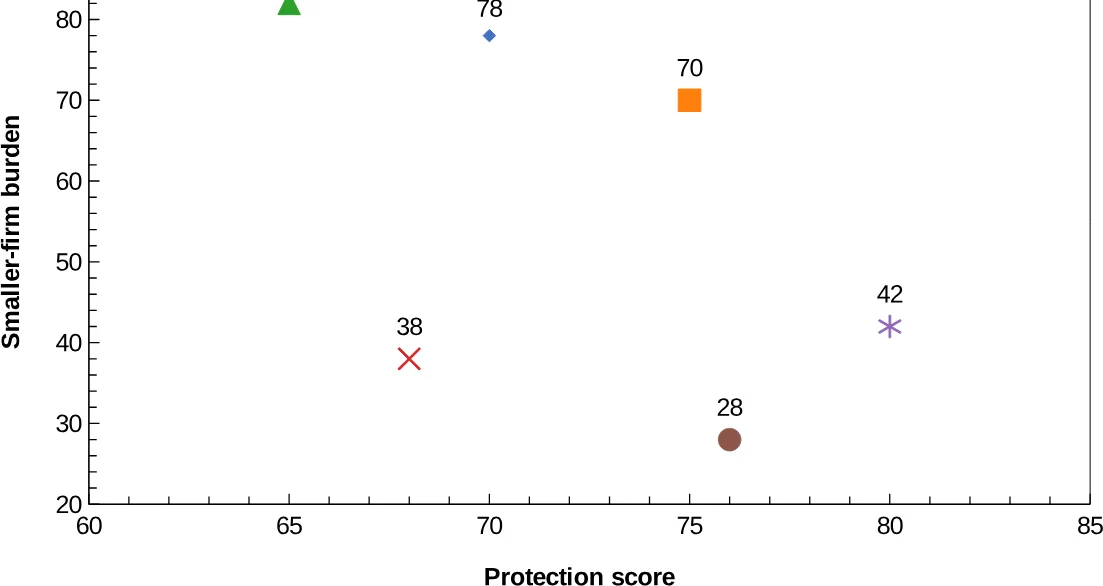
This subsection contrasts protection and burden of regulations for smaller firms between various regulatory packages. It decides whether or not stiffer protections lead to greater costs to comply. The policy designs are pinned on a matrix in figure 7, based on the protection and burden scores.
The most disjointed compliance has a 82 protection and a 65 compliance. The uncoordinated localization alternative has a burden rating of 78 and protection rating of 70 while the broad liability pass-through option has a burden rating of 70 and a protection rating of 75. Centralized screening is quite a bit simpler, and provides 80% protection. Interoperable transfer rules give us a burden of 38 and a protection of 68. Mutual recognition + one-stop compliance translates into 76 protection and the lowest burden of 28. Robustness checks will maintain the leading and trailing rankings. The coordinated designs are therefore supported, since the fixed costs of duplication are not lost, but do not diminish the level of regulatory protection, while the fragmented compliance will not attain the efficient frontier.
6. Discussion
The results indicate that digital regulation alters the competitive landscape in multiple ways: incidence of fixed costs and fragmentation of inputs and delegated enforcement. The compliance impact is felt not only at the administrative cost front but also in the formation of ventures, increase in financing intensity, demand for websites, revenues, technology supplier selection, and concentration. Ventures with the highest regulatory exposure, consumer-oriented, young, and early-stage, are the ones where losses were the greatest, consistent with the prediction that regulatory exposure and lack of organizational slack interact. This study complements previous studies on small firms' platform internationalization by placing the participation margin before the point of attaining scale (Da Rocha et al., 2024). Less funding per round combined with lesser online activity and a more focused compliance-technology landscape further highlights the need for digital capability and marketplace reliance for SME performance (Dallocchio et al., 2024).
The results of the localization show that there was a difference between substantive protection and territorial duplication. Domestic-use restrictions and regulatory heterogeneity have weaker effects on trade than do cross-border restrictions and regulatory heterogeneity. This is in line with the findings of research that argues that cross-country data governance is an institutional restriction for the international digital strategy (Coche et al., 2024; Ma et al., 2024). The cost of a domestic privacy obligation is also likely to increase; local processing or incompatible transfer assessments also break up infrastructure and supplier networks. Friction with the regulations and transition costs also influence the entrepreneur's reaction to implementation fragmentation (Ahern, 2021). The interpretation that the framework does not provide for is therefore the simple one that is a deregulatory one. The main distortion occurs when implementation prevents sharing the scale, and the possibility to relocate, negotiate, and organize is restricted to the big firms but not to the small firms.
There is a real policy choice to be made over whether or not to buy insurance to cover platform liability. Similar to a comparative product-liability analysis of online platforms [30], harmful sellers with few or no assets are made more responsible, which will lead to increased auditing and deterrence of participation in harmful sellers. The counterfactual results highlight an important edge case: platforms that are concentrated but opaque in their efforts and have a wide pass-through turn public enforcement into private exclusion. The lawful marginal sellers then have to pay a higher commission, document over and over, wait longer to list, or have to remove the product at a conservative rate. Network effects create a situation where innovation diminishes because access to a dominant marketplace becomes a must for the innovation to operate, as does the general fear that marketplace control redistributes risk and access to the marketplace to third parties [30]. The shared liability option, with visible screening, does better since it maintains the information advantage of the platform, while reducing undue cost transfers.
The theoretical contribution is an account of regulatory arbitrage that is based on capacity. The classic arbitrage question is which is the least onerous jurisdiction? The current structure involves making different strategic options within the same rule. Compliance becomes internalized by large companies, processing moves away, legal costs are distributed and platform deals are negotiated; compliance is not possible for smaller companies, they stay in-house or rely on one intermediary. Formal equality results in informal inequality. This is a mechanism that is compatible with the absence of explicit discriminatory language and could lead to simultaneous contraction and concentration of vendors.
In terms of the methodology, the separated-estimand architecture is free of misinterpretation of precision. Percentages that involve quasi-experimental designs, panel restrictions and structural sign conditions provide different answers to different questions. The calibrated benchmarks and direction models help to compare policies without using observed firm-specific scores as a representation of theory. The size of employment more frequently co-occurred with the other variables (venture age, stage, data reliance, and customer orientation) than with platform-liability reform in the context of direct causal estimates of platform-liability reform on cross-border small sellers. Future identification could be enhanced with linked platform, customs and firm panels.
Practical implication coordinated protection and not weaker. Interoperable transfers, common reporting interfaces, portable verification, transparent screening and proportional thresholds are ways to minimize duplication, maintain privacy, safety and accountability. The frontier results suggest that there is a coordinated package of activities, rather than fragmented compliance. Implementation architecture, cost transfers on platforms, rights of appeal and the involvement of smaller firms are therefore important issues that must be addressed jointly through trade arrangements and in the regulatory framework.
Another policy implication is on sequencing. If there is a requirement for these platforms to be liable before there is some shared verification, some uniform notices, and credible appeals then there is a far greater chance that the platforms will react with blanket exclusions. The first change that introducing interoperable compliance infrastructure will bring to the platform's least cost response is from removal to targeted monitoring. The conclusions also help to put competition policy in the context of digital-trade governance. When compliance vendors control the price of compliance, it is influenced by concentration and reliance on dominant marketplaces. Private bottlenecks to access, which are not captured by only monitoring formal statutory equality, exist. Distributional measures should thus be provided for seller entry, reinstatement, vendor switching, financing stage, and reliance on the data. Trade values of the surviving firms would be misleading if only aggregate trade values were added up because smaller firms left the market.
7. Conclusion
In fact, digital trade regulation is becoming a more significant factor in determining who trades across borders – rather than just in how it's documented. This study explored the causal and structural consequences of data localization, platform liability and cross-border compliance on the smaller parties through the use of a calibrated benchmark design. Quasi-experimental regulatory shocks were used to anchor observed changes in the investment, website activity, revenue, technology vendor use and concentration. The channels identified by the panel results were linked to data restrictions, while the structural counterfactuals were linked to the conditions that lead to more effective enforcement or to deterring the entry of lawful sellers by the platform.
The results are the same for each of the estimand classes. The losses are highest for the newer, data-driven, consumer-oriented and nascent businesses. These trade impacts are more pronounced than the usual domestic data-use rules due to the cross-border restrictions on transfers and to the regulatory differences. Platform responsibility enhances auditing with sellers having no recoverable assets, but with centralized platforms and effort transparency and widespread pass-through comes entry and innovation losses. One of the most desirable protection-burden trade-offs is on the interoperable transfers end of the protection-burden continuum, which is the end of the centralized transparent screening end, the mutual recognition end, the proportionate thresholds end, and the one-stop reporting end.
The contribution provides an integrated perspective on capacity-based regulatory arbitrage, the ability of large firms to have organizational avenues around rules that are fragmented and the challenge faced by smaller firms of the indivisible costs of the market specific rules. There are some constraints such as lack of platform seller panels, lack of complete reporting in terms of employment size and inability to forecast liability limits as opposed to actual monetary amounts. Future studies should combine administrative, platform, customs and firm data linked by time and refer to different regulatory periods, providing explicit estimates of entry, delisting, compliance costs, innovation and survival as a function of firm size and across regulatory changes.
8. Recommendations
Substantial privacy, safety and accountability along with elimination of duplicative implementation is required for regulators. Implement mutually recognized interoperable transfer mechanisms with standardised contractual clauses, and common risk assessment template. Establish a single digital compliance platform, encompassing data-transfer, customs, tax, product and platform compliance requirements, via re-usable firm credentials. Document and audit in proportion to the inherent risk of the transactions, the sensitivity of the data and the size of the seller, not on the number of procedures.
It is essential to have clear allocation rules in platform-liability regimes. Implement safe harbor for documented screening effort, timely handling of notices, reasons for removal and ability to appeal. Ban undisclosed liability surcharges, and mandate that platforms break out by firm-size class the numbers of platforms that comply with the compliance fee pass-through, suspensions by sellers, reinstatements, and the impact of the compliance fee on cross-border platforms. Allow portability of verification, so that a lawful seller doesn't have to verify their identity, products, and safety over each and every marketplace.
Trade agreements must have operational commitments in addition to any abstract language of data-flow. Add regulator-to-regulator cooperation and compatibility of technical standards, review on implementation and impact assessment of smaller firms. The competition authorities should review for any trends of vendors that make their compliance products and cloud service suppliers turn regulation into exclusionary scale benefits, or dominant platforms turning it into exclusionary size benefits. Firm outcomes are required for these periodic evaluations, including entry, exports, investment, delisting, innovation and survival.
Author Contributions
Conceptualization, methodology, data curation, formal analysis, visualization, writing—original draft, and writing review and editing: Author.
Conflict of Interest
The author declares no conflict of interest.
References
- Ahern, D. (2021). Regulatory Lag, Regulatory Friction and Regulatory Transition as FinTech Disenablers: Calibrating an EU Response to the Regulatory Sandbox Phenomenon. European Business Organization Law Review, 22(3), 395–432. https://doi.org/10.1007/s40804-021-00217-z
- Aridor, G., Che, Y., & Salz, T. (2023). The effect of privacy regulation on the data industry: Empirical evidence from GDPR. The RAND Journal of Economics, 54(4), 695–730. https://doi.org/10.1111/1756-2171.12455
- Burri, M. (2023). The Impact of Digitalization on Global Trade Law. German Law Journal, 24(3), 551–573. https://doi.org/10.1017/glj.2023.29
- Coche, E., Kolk, A., & Ocelík, V. (2024). Unravelling cross-country regulatory intricacies of data governance: The relevance of legal insights for digitalization and international business. Journal of International Business Policy, 7(1), 112–127. https://doi.org/10.1057/s42214-023-00172-1
- Cumming, D., Johan, S., Khan, Z., & Meyer, M. (2023). E-Commerce Policy and International Business. Management International Review, 63(1), 3–25. https://doi.org/10.1007/s11575-022-00489-8
- Da Rocha, A., Neves Da Fonseca, L., & Kogut, C. S. (2024). Small firm internationalization using digital platforms: An assessment and future research directions. International Marketing Review, 41(5), 981–1015. https://doi.org/10.1108/IMR-10-2023-0280
- Dallocchio, M., Lambri, M., Sironi, E., & Teti, E. (2024). The Role of Digitalization in Cross-Border E-Commerce Performance of Italian SMEs. Sustainability, 16(2), 508. https://doi.org/10.3390/su16020508
- Eduardsen, J., Marinova, S., Leonidou, L. C., & Christodoulides, P. (2023). Organizational Influences and Performance Impact of Cross-Border E-Commerce Barriers: The Moderating Role of Home Country Digital Infrastructure and Foreign Market Internet Penetration. Management International Review, 63(3), 433–467. https://doi.org/10.1007/s11575-023-00500-w
- Elia, S., Giuffrida, M., Mariani, M. M., & Bresciani, S. (2021). Resources and digital export: An RBV perspective on the role of digital technologies and capabilities in cross-border e-commerce. Journal of Business Research, 132, 158–169. https://doi.org/10.1016/j.jbusres.2021.04.010
- Ferracane, M. F., Kren, J., & Van Der Marel, E. (2020). Do data policy restrictions impact the productivity performance of firms and industries? Review of International Economics, 28(3), 676–722. https://doi.org/10.1111/roie.12467
- Goldberg, S. G., Johnson, G. A., & Shriver, S. K. (2024). Regulating Privacy Online: An Economic Evaluation of the GDPR. American Economic Journal: Economic Policy, 16(1), 325–358. https://doi.org/10.1257/pol.20210309
- Gusenbauer, M., Könitzer, S., & Kitowski, M. (2025). A remedy for the liability of smallness? How digital work platforms augment the smallest enterprises. Review of Managerial Science, 19(9), 2867–2898. https://doi.org/10.1007/s11846-025-00834-9
- Hervé, A., Schmitt, C., & Baldegger, R. (2020). Digitalization, Entrepreneurial Orientation & Internationalization of Micro-, Small-, and Medium-Sized Enterprises. Technology Innovation Management Review, 10(4), 5–17. https://doi.org/10.22215/timreview/1343
- Hua, X., & Spier, K. E. (2025). Holding Platforms Liable. American Economic Journal: Microeconomics, 17(4), 68–101. https://doi.org/10.1257/mic.20230282
- Jeon, D., Lefouili, Y., & Madio, L. (2026). Platform Liability and Innovation. International Economic Review, 67(3), 763–778. https://doi.org/10.1111/iere.70045
- Jia, J., Jin, G. Z., & Wagman, L. (2021). The Short-Run Effects of the General Data Protection Regulation on Technology Venture Investment. Marketing Science, 40(4), 661–684. https://doi.org/10.1287/mksc.2020.1271
- Johnson, G. A., Shriver, S. K., & Goldberg, S. G. (2023). Privacy and Market Concentration: Intended and Unintended Consequences of the GDPR. Management Science, 69(10), 5695–5721. https://doi.org/10.1287/mnsc.2023.4709 Kim, J.-Y. (2024). Seller liability versus platform liability: Optimal liability rule and law enforcement in the platform economy. European Journal of Law and Economics, 58(1), 119–148. https://doi.org/10.1007/s10657-024-09813-z
- Li, Y., & Zhu, S. (2024). Impact of digital services trade restrictiveness on manufacturing export efficiency. Applied Economics, 56(58), 8447–8461. https://doi.org/10.1080/00036846.2023.2290596
- Li, Z., Lee, G., Raghu, T. S., & Shi, Z. (Michael). (2025). Impact of the General Data Protection Regulation on the Global Mobile App Market: Digital Trade Implications of Data Protection and Privacy Regulations. Information Systems Research, 36(2), 669–689. https://doi.org/10.1287/isre.2022.0421
- Ma, S., Huang, S., & Wu, P. (2024). Data policy restrictions and cross-border E-commerce: Evidence from China. Journal of Asian Economics, 95, 101826. https://doi.org/10.1016/j.asieco.2024.101826
- Meyer, K. E., Li, J., Brouthers, K. D., & Jean, R.-J. ‘“Bryan.”’ (2023). International business in the digital age: Global strategies in a world of national institutions. Journal of International Business Studies, 54(4), 577–598. https://doi.org/10.1057/s41267-023-00618-x
- Peukert, C., Bechtold, S., Batikas, M., & Kretschmer, T. (2022). Regulatory Spillovers and Data Governance: Evidence from the GDPR. Marketing Science, 41(4), 746–768. https://doi.org/10.1287/mksc.2021.1339
- Reshef, O. (2023). Smaller Slices of a Growing Pie: The Effects of Entry in Platform Markets. American Economic Journal: Microeconomics, 15(4), 183–207. https://doi.org/10.1257/mic.20220055
- Stallkamp, M., & Schotter, A. P. J. (2021). Platforms without borders? The international strategies of digital platform firms. Global Strategy Journal, 11(1), 58–80. https://doi.org/10.1002/gsj.1336 Van Der Marel, E., & Ferracane, M. F. (2021). Do data policy restrictions inhibit trade in services? Review of World Economics, 157(4), 727–776. https://doi.org/10.1007/s10290-021-00417-2
- Yang, F., Wang, Y., & Whang, U. (2024). Trade restrictions on digital services and the impact on manufacturing exports. The Journal of International Trade & Economic Development, 33(4), 523–550. https://doi.org/10.1080/09638199.2023.2195958
- Zhang, H., Kim, H., & Moon, S. (2025). The Effects of Data Restriction Policies and Institutions on Digital Financial Service and Trade. Emerging Markets Finance and Trade, 61(9), 2745–2762. https://doi.org/10.1080/1540496X.2025.2467190
CITE THIS ARTICLE
Jawad, A. (2026). Digital Trade Without Regulatory Arbitrage: Causal Effects of Data Localization, Platform Liability, and Cross-Border Compliance on Smaller Firms. https://www.researchbyasif.com/article/9c098d5e-cdf9-4384-a436-a4a99706335b
A. Jawad, “Digital Trade Without Regulatory Arbitrage: Causal Effects of Data Localization, Platform Liability, and Cross-Border Compliance on Smaller Firms,” 2026. [Online]. Available: https://www.researchbyasif.com/article/9c098d5e-cdf9-4384-a436-a4a99706335b
Jawad, A. (2026) ‘Digital Trade Without Regulatory Arbitrage: Causal Effects of Data Localization, Platform Liability, and Cross-Border Compliance on Smaller Firms’. Available at: https://www.researchbyasif.com/article/9c098d5e-cdf9-4384-a436-a4a99706335b
Jawad, Asif. “Digital Trade Without Regulatory Arbitrage: Causal Effects of Data Localization, Platform Liability, and Cross-Border Compliance on Smaller Firms.” 2026, https://www.researchbyasif.com/article/9c098d5e-cdf9-4384-a436-a4a99706335b.
Asif Jawad. “Digital Trade Without Regulatory Arbitrage: Causal Effects of Data Localization, Platform Liability, and Cross-Border Compliance on Smaller Firms.” (2026). https://www.researchbyasif.com/article/9c098d5e-cdf9-4384-a436-a4a99706335b.
Jawad A. Digital Trade Without Regulatory Arbitrage: Causal Effects of Data Localization, Platform Liability, and Cross-Border Compliance on Smaller Firms. 2026. https://www.researchbyasif.com/article/9c098d5e-cdf9-4384-a436-a4a99706335b
@misc{article_9c098d5ecdf94384a436a4a99706335b,
  title = {Digital Trade Without Regulatory Arbitrage: Causal Effects of Data Localization, Platform Liability, and Cross-Border Compliance on Smaller Firms},
  author = {Asif Jawad},
  year = {2026},
  url = {https://www.researchbyasif.com/article/9c098d5e-cdf9-4384-a436-a4a99706335b},
}
TY - GEN AU - Asif Jawad TI - Digital Trade Without Regulatory Arbitrage: Causal Effects of Data Localization, Platform Liability, and Cross-Border Compliance on Smaller Firms PY - 2026 UR - https://www.researchbyasif.com/article/9c098d5e-cdf9-4384-a436-a4a99706335b ER -