While automated public decisions will be fast and consistent, the lack of transparency around decision-making, inadequate appeals and administrative capacity will undermine the legitimacy of such decisions in Bangladesh. The study explores the relationship between contestability and public trust and how AI governance and organisational capacity contribute to this. Six high impact domains of decision making have been evaluated for transparency, explanation, review, audit, data protection, staffing, interoperability, grievance handling and inclusion, in the context of an institutional audit conducted in Bangladesh. The audit informed a Monte Carlo policy experiment that was conducted across baseline, governance, capacity, integrated and automation-acceleration scenarios, involving 60,000 stratified decisions encountered. The average scores for baseline trust were 44.3, governance readiness was 32.3, and capacity readiness was 61.1. Integrated reform led to an increase in trust to 64.7, filing in appeal to 61.3%, and decreasing the number of unresolved erroneous decisions from 24.5% to 13.5%. The interactions between governance and capacity were positive and digital literacy and disability continued to have negative impacts. There is a need for reviewability, operational redress and capability to be inclusive for contestable government, not just transparency.
Research ArticleAI Governance and Public AdministrationIn progress
From Automated Decisions to Contestable Government in Bangladesh: How AI Governance and Administrative Capacity Shape Public Trust
Correspondence: asifjawad4567@gmail.com
Abstract
Keywords Public-sector artificial intelligenceContestabilityAdministrative capacityAlgorithmic accountabilityPublic trustBangladesh
1. Introduction
Bangladesh has transitioned from siloed e-government initiatives to a more cohesive digital government where elements like identity-based systems, administrative databases, online portals, and automated processes have become more prevalent in shaping access to public authority. According to the 2024 E-Government Development Index (EGDI) by the United Nations, the country has improved significantly in online services and telecommunications infrastructure with a score of 0.6570 and a rank of 100 in the E-Government Development Index (UNITED NATIONS, 2024; Zhang & Bhattacharjee, 2024). The World Bank's GovTech framework does not consider digital citizen engagement, institutional enablers, legal safeguards and workforce capability as a part of the provision of online services (World Bank, 2025). In this sense, the difference is at the heart of the issue with AI, as a system that technically works well can be illegitimate if people don't have reasons to correct it, or some human review to check it.
Various initiatives have been undertaken to strengthen the platform for data-driven administration, including shared infrastructure, cybersecurity, skills, and digital public services. There are several initiatives in place to build up the platform of data-based administration, such as shared infrastructure, cyber security, skills, and digital public services. Priority areas were identified as public services, agriculture, health, transport, education and finance by the National Strategy for Artificial Intelligence and ties were established between using AI and national development planning (Vatamanu & Tofan, 2025). In the Draft National Artificial Intelligence Policy 2024, the principles of equity, transparency and accountability, safety, human-centred design, risk classification, and institutional coordination were added (ICT Division, 2020). The Personal Data Protection Ordinance and National Data Governance Ordinance were introduced in the late 2025 which further enhanced the formal data-governance environment (ICT Division, 2024). Previously, cyber laws focused more on cyber-security and cyber-crimes as opposed to specific protection for automated administrative decisions (Roy, 2025). This is a very special institutional time because of the parallel processes of technical adoption and an imperfect operational structure for providing notice, explaining, appealing, auditing and remedying.
Public-sector AI is not a typical form of digital service delivery, as it wields or has an impact on coercive, distributive power. Automated eligibility screening, risk classification, identity matching, recruitment filtering, and enforcement triage affect income, mobility, employment, property, and liberty. On comparing the algorithms used in public sector with those used in private sector, it has been found that the public sector algorithms reinforce power inequality because it is the citizens who pay for detecting errors in the algorithm (Kuziemski & Misuraca, 2020). Governance mechanisms that maintain the legality, individual approach and accountable discretion are thus necessary to ensure efficiency gains (Henman, 2020). Integrated AI-governance frameworks see opacity, discrimination, lack of responsibility, security issues and organizational reliance as interrelated risks (Wirtz et al., 2020). Reviews of the research on public governance also show that there has been a long-standing lack of research providing explanatory, context-specific links between formal safeguards and capacity for their implementation (Zuiderwijk et al., 2021).
This is not the issue of the lack of ethical principles. The issue is how to put principles into a contestable administration process. Identifiable decision ownership, system output records that allow the reconstruction of the path taken to the decision, institutional authority to review outputs and consequences of system failure are all necessary for accountability (Busuioc, 2021). Trust is also based on the state's ability to offer familiarity, control and protection from technology failure, and not only citizens' confidence in the models' accuracy (Bodó & Janssen, 2022). Empirical studies have shown that citizens' trust in AI-based governance is related to its perceived competence, fairness, transparency, participation and institutional performance (Robles & Mallinson, 2025). However, there are also compromises within good-governance values, as can be seen from the following: speed can be in conflict with deliberation, standardization with contextual judgment, and the technical consistency with corrective discretion (Roehl & Hansen, 2024).
Much of the research focuses on the study of the mature administrative system, individual treatments for transparency, barriers to widespread adoption, and a doctrinal obligation. Their findings are not necessarily linked to how governance protects and administrative capacity is linked in a lower-middle-income country with high rates of digitisation, with limited frontline capacity and resources, with disjointed data systems, and with changing data laws (Baxter et al., 2023). Digital transformation and regulatory objectives are mentioned in the context of Bangladesh in news reports, but it is not often done with a measurement of contestability on the different decision domains or an estimation of the consequences of trust for governance-only, capacity-only, and integrated reform.
Another restriction relates to the common practice of treating explanation as a sufficient remedy, although it is dependent on the competence of staff, the ability to communicate, to keep records, to have grievance procedures in place and have the authority to do so. Bangladesh also poses significant distributional issues since living in rural areas, being low-income, having a disability, or having multiple languages also is likely to affect the costs of learning about a decision and taking steps to correct it. The governance model that might seem sufficient at a central level of the organization ends up creating inequities at the operational level, when there are no aligned processes at local offices, call centres and portals.
This study explores the relation between AI governance and contestability of public decisions through automation (AI) as well as citizens' trust in Bangladesh. The general objective is to seek to ascertain the potential of transparency, explanation, appeal, review and correction procedures to provide fair and reliable results if they are backed by sufficient institutional capacity, technical skills, and coordination of administration. In addition, the analysis examines how well a cooperative approach to governance and capacity building works, compared with other types of interventions, such as those for citizens who are digitally or socioeconomically disadvantaged.
The study identifies a policy-level framework for assessing public-sector AI systems in Bangladesh that can be implemented. It interweaves public management, administrative law, algorithmic accountability and social inclusion to highlight the conditions for the implementation of formal protection. The framework offers a clear foundation for policymakers to design secure and contestable public services through AI that will strengthen public trust through inclusion and be accountable.
2. Literature Review
2.1 From digital administration to AI-mediated authority
The digital administration not only alters the places of service delivery but also the place of discretion of the bureaucracy. Bullock states that AI does not take away from judgment, but rather it adds discretion to the role of officials, organizations, data infrastructures, and system designers (Bullock, 2019). They differentiate between two types of discretion: Artificial discretion can enhance the discretion of the official, while arrangements can replace human discretion (Young et al., 2019). Public authority, however, is still attributed in the context of technical systems in the case of classification, ranking, or recommendation. The digital-cage account illustrates how information architectures that are limited and rigid prevent citizens whose situation is outside of their classifications from using information and can be considered a form of administrative denial (Peeters & Widlak, 2018).
The additional administrative burden research has shown is that procedures that are complex or have restricted access to digital are unevenly distributed among citizens, with a psychological cost also being incurred as the costs of learning and compliance (Huo et al., 2025). Eubanks' examination of automated welfare systems also reveals the disproportionate harms of surveillance and error that are created in the administration of welfare for low-income groups (Gordon, 2019). These studies place AI in institutional decisions on categorization, data, discretion and access and counter the notion that automation is simply a neutral replacement of the subjective character of bureaucracy. This perspective deems a disputed output to be an administrative relation, rather than just a prediction. The quality therefore is dependent on those who set up categories, who are informed, who have to verify and what authority has the power to change the result.
2.2 Contestability, reviewability, and administrative legality
The ability to comprehend, question and request reconsideration of an unfavorable determination. Suksi sees five elements as essential in automated administration as regards the requirement of due process: notice, reasons, delegated authority, human responsibility and effective appeal (Suksi, 2021). Reviewability applies this to the socio-technical process by keeping records of data provenance, model operations, decisions made by organizations, human actions, and subsequent actions after decisions have been made (Cobbe & Singh, 2020). Cobbe, Lee and Singh propose that reviewability is a characteristic of the system design, and not only the system's insides, because accountability is related to reconstructing a pathway to the decision. Cobbe, Lee and Singh propose that reviewability is a quality of the system design, and not just the system's guts, because accountability has to do with reconstructing a pathway to the decision. Explanation trade-offs are comprehensibility, accuracy, security, privacy and institutional interests as shown by (De Bruijn et al., 2022). In a series of examples, Green illustrates how inadequate algorithmic oversight, a lack of time, and insufficient authority to reject algorithmic results can seem to legitimate their use even if that is not the case (Green, 2022).
The phenomenon of automation bias and selective adherence have been confirmed through experiments with public officials (Alon-Barkat & Busuioc, 2023). Thus, a human sign would not really constitute meaningful review. Four conditions must be met for contestability: There are procedural rights, competent reviewers, traceable records, accessible channels, and remedial power. Reviewability is also a different notion from reversibility. A system is reviewable if it has a pathway that can be inspected and it is reversible if it has a competent institution, lawful authority, and a mechanism to change the status of the citizen when error is found that is timely.
2.3 Administrative capacity, burden and implementation
For AI governance, there is a need for resources from organisations which formal rules cannot provide alone. Public agencies need to have access to reliable data, procurement skills, technical staff, trained case officers, interoperable records, complaint process and leadership to be able to put an end to an unsafe deployment. Administrative burden theory suggests that low implementation results in increased complexity being placed on the claimant due to repeated documents, interfaces that are not user-friendly, travel, delay and uncertainty (Batool et al., 2025). Reviewability studies also regard the organization's records and the responsibility assigned as prerequisites for making accountable decisions (Cobbe et al., 2021). AI research by public sector frameworks pinpoints organizational issues like data fragmentation, technical reliance, accountability challenges, and inadequate monitoring (Bodó & Janssen, 2022).
This is reflected in the variations in the emphasis found in the literature. Capacity-based accounts of technology adoption often capture the idea that capacity is a prerequisite to successful technology adoption, while administrative-law-based accounts capture the idea that capacity is a precondition to lawful authority. The latter is more convincing as it relates to high-impact decisions as the lack of reasons, review and remedy caused by shortages, disjointed records, or poor grievance offices impact not only operational performance, but also reasons, review and remedy. There are therefore two aspects of capacity productive capacity and constitutional capacity. It shapes the number of services that will be provided and, more importantly, where services will gain practical significance when citizens interact with local offices, digital portals, call center, and outsourced service providers.
2.4 Public Trust, Procedural Fairness and Legitimacy
Public perception of automated government is a reflection of perceptions of technology as well as the institution using the technology. Araujo and colleagues determined that the attitudes towards automated decision making differ depending on context, human interaction, and social implications of AI (Araujo et al., 2020). Citizens assess the government's AI not only based on performance but also on the perceived fairness, usefulness, accountability, and risk aspects of the AI (Ingrams et al., 2022). Grimmelikhuijsen demonstrated that transparency has a positive impact on perceived trustworthiness by changing either explanation quality or intelligibility, but that there is not much benefit in having too much detail (Grimmelikhuijsen, 2023). Trust is therefore not the same as trustworthiness, the former being an attitude, and the latter being properties and institutions that justify being trusted.
Robles and Mallinson link the trust that can be generated through AI with the performance of institutions, their competence, fairness, transparency, and participation (Robles & Mallinson, 2025). Bodó and Janssen believe that governments should still have the responsibility for the technological parts as the failure of services contributes to loss of trust in the service infrastructure of a government (Bodó & Janssen, 2022). The results are mostly consistent across the three dimensions of procedural fairness, but are not as uniform on transparency and human involvement. The paradox makes sense when you think about capacity coming into the picture: explanations when there's no communication or review in time and ability make symbolic safety.
Procedural experience consequently supplies the link between institutional design and trust. Citizens not only assess the result, but they also assess if the state is intelligible, open to challenge, investigates failure, and restores the position that it has sunk into as a result of a wrong decision.
2.5 Bangladesh's governance environment and the unaddressed gap
Bangladesh looks like a nation with a robust base for high-impact automation but weak ones. Bangladesh has uneven bases for high-impact automation and high-quality digital service infrastructure. Shared infrastructure and cyber security, training and service platforms are part of the investment in digital government (World Bank, 2025). The national AI strategy set out with the ambition to incorporate sectoral ambitions (Vatamanu & Tofan, 2025), and the draft policy of 2024 included proposals for institutional aspects, risk-based governance and accountability principles (ICT Division, 2024). The reforms in personal data and in data governance in 2025 have reinforced rights and organizational responsibilities, but have left unresolved the implications of the reforms for appeals to administrative bodies, sectoral regulators, and automated decisions. These developments can be seen as an element of technical and policy preparation; however, contestability cannot just be measured by readiness indices.
Despite the focus of the work being on Bangladesh, the work still revolves around adoption, access to services and policy aspiration. It does not take into account the interaction of notice, explanation, review, appeal, audit, data protection, staffing, interoperability, grievance ability, and access to various resources in the context of adverse decisions. It also does not explain if there is a net gain in trust when there is formal governance reform and the local administration capacity is weak. This is thus a gap of causality and institutions, not of description. The present study tackles this issue by using a domain audit and policy simulation that focus on corrective outcomes and distributional impacts. There is a distributional aspect of the gap too. National rules are lacking for situations where citizens in low connectivity areas or households with disabilities or in rural regions have increased difficulty accessing documents and finding an approved reviewer, or identifying an adverse result.
3. Conceptual and Theoretical Framework.
The study takes a holistic approach to the contestability, capacity and trust matrix and presents it in a causal structure to support high impact public decisions and decisions in public spaces. Reviewability includes governance protections such as notice, understandable reasons, access to data, record of actions, human reconsideration, appeal, independent audit, subgroup testing and responsibility (Cobbe et al., 2021). Administrative burden represents the learning, compliance and psychological costs citizens face as they challenge decisions and institutional trust is the confluence of these costs and feelings of competence, fairness, control and protection against technological failure (Bodó & Janssen, 2022).
The framework contains two exogenous constructs: AI-governance readiness and administrative-capacity readiness. Governance readiness is about the processes and procedures in place, while capacity readiness is about the quality of data, interoperability, reviewers being trained, grievance integration, channels being accessible, logging, and workload capability. The interaction between them is the driving force, as with no capacity, governance creates paper rights, and with capacity, but no governance, efficient systems can be in place with little contestability. Figure 1 presents these relationships and the specified causal pathways.
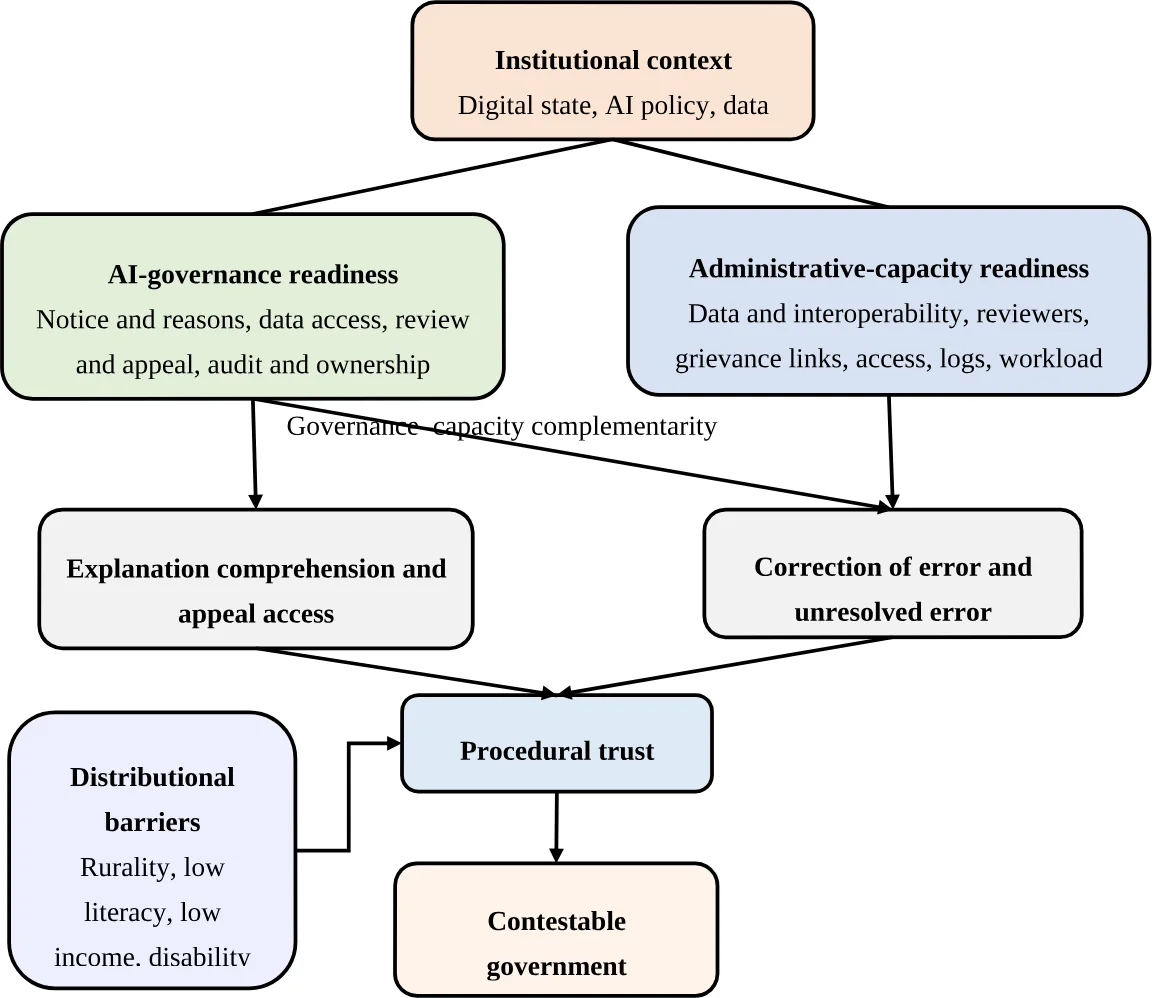
The readiness to procedural trust is mediated by four mediators, namely: comprehension of the explanation, access to the appeal, corrective performance, and unresolved error. Additionally, the model differentiates between the formal availability of safeguards and the actual use of safeguards, and between the capacity and the institutional ability to actually provide safeguards. The pathways are moderated by rural residence, low digital literacy, low income, and disability, which add to information costs, travel costs, and communication and interface costs; sex is kept as a control. Procedural trust (0–100) is likely to increase when explanations facilitate easy review and meaningful correction of errors, and to decrease when they do not. The framework foresees higher trust-building effects for integrated reform than for isolated interventions, as well as ongoing subgroup differences with limited accessibility.
4. Methodology
4.1 Research design and analytical strategy
A survey of the normative institutions was conducted, followed by a Monte Carlo policy experiment. This design aimed to tackle the following challenges: lacked uniformity in using AI in the public sector, limited administrative data, and the absence of survey evidence of any adverse automated decisions. The governance and operational readiness were identified as audit items and simulation items included error, explanation, appeal, correction, unresolved error, and procedural trust. The estimates are comparative policy and are based on reported policy conditions, explicit assumptions, fixed policy coefficients and multiple, random encounters with a policy rather than on observed national attitudes.
4.2 Bangladesh setting and decision domains
The six high-impact domains - social-protection eligibility, land mutation and registration, tax and value added tax compliance, identity and passport verification, public recruitment screening and policing and surveillance triage – were chosen because of their rights implications, distributive consequences, their reliance on data, discretion and potential use by AI. Based on digital-government strategies, AI-policy documents, data-governance tools, cybersecurity policies, grievance processes and implementation records. Safeguard definitions and coding anchors were not based on Bangladesh-specific scores, but on international standards.
4.3 Construct measurement and audit protocol
The set of eight indicators that were used for AI-governance readiness were equally weighted: public disclosure and registration, individual reasons, access to relevant data, meaningful human review, accessible appeal, independent audit, subgroup-impact testing, and responsibility assignment. The capacity readiness for administration included six indicators: Data quality and interoperability, competence of the reviewers, integration of the grievance, offline or multilingual access, decision logging, and workload capability. The indicators were scored as 0 (no provision), 1 (partial provision or policy provision) and 2 (operational provision). Scores were re-scaled between 0-100, and re-indexed to 0-1. A complexity parameter was used to capture the factual diversity, legal discretion and severity of the decision. A documentation, decision rule and uncertainty for each score were recorded. The implementation was not clear, so conservative coding was used, and then cross domain consistency checking was done.
4.4 Policy experiment and scenario specification
This experiment resulted in 60,000 encounters – 2,000 within each of six domains and five scenarios. The other factors were generally assigned as follows: Rural residence, low digital literacy, low income and sex followed a balanced Bernoulli assignment at 0.50, and disability followed a Bernoulli assignment at 0.10. These values did not report the prevalence of the population but they were used for comparison between subgroups. Scores retained as a baseline were those that were audited. Governance reform resulted in governance being raised by 0.30, capacity reform was raised by 0.25, and integrated reform was a combination of both changes. The factors of 'automation acceleration', 'governance' and 'complexity' each contributed to capacity growth of 0.10, 0.15 and 0.10 respectively.
The model used for encounter in domain was:
[P(Error_{id})] =-1.25-1.15C_d+1.45K_d+0.20L_i(1-0.40C_d)+0.10R_i(1-0.40C_d)[P(Explain_{id})] =-1.10+2.50G_d+0.80C_d-1.05(1-0.65G_d)D_i-0.30(1-0.55C_d)R_i-0.50(1-0.55G_d C_d)Q_i[P(Appeal_{id})] =-1.75+2.20G_d+0.80C_d+0.85E_i-0.70(1-0.65G_d)D_i-0.38(1-0.55C_d)R_i-0.28(1-0.45C_d)L_i-0.38(1-0.55G_d C_d)Q_i[P(Correct_{id})] =-0.65+1.30G_d+1.80C_d-0.25K_d-0.30(1-0.55C_d)D_i Trust_{id}=29+19G_d+13C_d+15G_d C_d+7E_i+5A_i+11S_i-17U_i-subgroup penalties+ε_i B_d=1-0.75G_d C_d
Here, G_ddenotes governance readiness, C_dcapacity readiness, and K_ddomain complexity. R_i, D_i, L_i, and Q_idenote rural residence, low digital literacy, low income, and disability. E_i, A_i, S_i, and U_irepresent explanation, appeal, correction, and unresolved error. Probabilities were bounded between zero and one, and trust was clipped to 0–100.
4.5 Estimation, uncertainty, and robustness
Estimates of scenario means were conducted for trust, error, explanation, appeal, correction (when there were errors in the appealed decisions) and unresolved error. An ordinary least-squares model was used to estimate trust, based on governance, capacity, the interaction between these, and pathway variables and subgroup control variables, with standard errors adjusted for HC3. Robustness tests were carried out with three different levels of governance (0.25, 0.30, and 0.35) each, plus three levels of capacity (0.20, 0.25, and 0.30) each, combined with governance-capacity weights of ±5%, and random seeds across 270 replications. The results for the integrated-reform trust gains were in the range of 16.4 to 23.9 points, and for the reductions in unresolved errors, the results were in the range of 8.0 to 12.7 percentage points within the central 95% range.
4.6 Validity, ethics and limitations of interpretation
Construct validity was built based on the principles of risk, rights, accountability and public administration. Context validity was further enhanced by the use of Bangladesh-specific legal, digital-government, grievance and implementation materials. Gaining context validity was further enhanced through the use of Bangladesh-specific legal, digital-government, grievance, and implementation materials. None of the personal records or human participants were used, so a formal ethics approval was not needed. One limitation is in terms of external validity. Modeled trust is a product of the procedure and policy rather than a survey estimate. The design includes capacity for comparative reform analysis and mechanism testing, but not claims about the national opinion at this time.
5. Results
5.1 Domain-level institutional readiness and baseline operational risk
This subsection is a starting point for public decision-making processes in an automatic setting of institutions. It examines both the governance readiness and administrative capacity, the extent to which errors are exposed, the level of appeal activity, and the failure to resolve the error. The comparison is relevant, because the levels of digital maturity at the national level are not enough to build trust, it is the service environment that matters. The institutional and operational profile presented in Table 1.
Table 1. Domain-level institutional readiness and baseline operational risk
| Decision domain | Governance | Capacity | Error (%) | Appeal (%) | Unresolved error (%) |
|---|---|---|---|---|---|
| Identityandpassport | 25.0 | 75.0 | 19.2 | 31.4 | 15.0 |
| Land administration | 37.5 | 66.7 | 31.8 | 38.9 | 23.6 |
| Policingandsurveillance | 6.2 | 33.3 | 44.3 | 16.4 | 41.2 |
| Public recruitment | 43.8 | 58.3 | 31.0 | 41.6 | 23.2 |
| Social protection | 43.8 | 58.3 | 33.4 | 40.1 | 25.5 |
| TaxandVAT selection | 37.5 | 75.0 | 25.4 | 39.7 | 18.2 |
| Mean | 32.3 | 61.1 | 30.9 | 34.7 | 24.5 |
There was a clear gap between what the operational capacity and readiness for governance was. Average capacity of 61.1 was achieved, as was an average of 32.3 for governance readiness. All three of the capacity scores for identity administration and tax selection were 75.0, while governance scores were unchanged at 25.0 and 37.5. Policing and surveillance was the lowest domain in both governance (6.2 points) and capacity (33.3 points), with 44.3% of errors being uncorrected, and 41.2% of errors being detected. All the identity services had the lowest rate of unresolved errors, 15.0%. In Figure 2, one can see that across the domains, reform brings about the greatest difference in trust from a baseline to an integrated-reform state, with a citizen-facing change in the domain of access to education, where there is the lowest baseline trust.
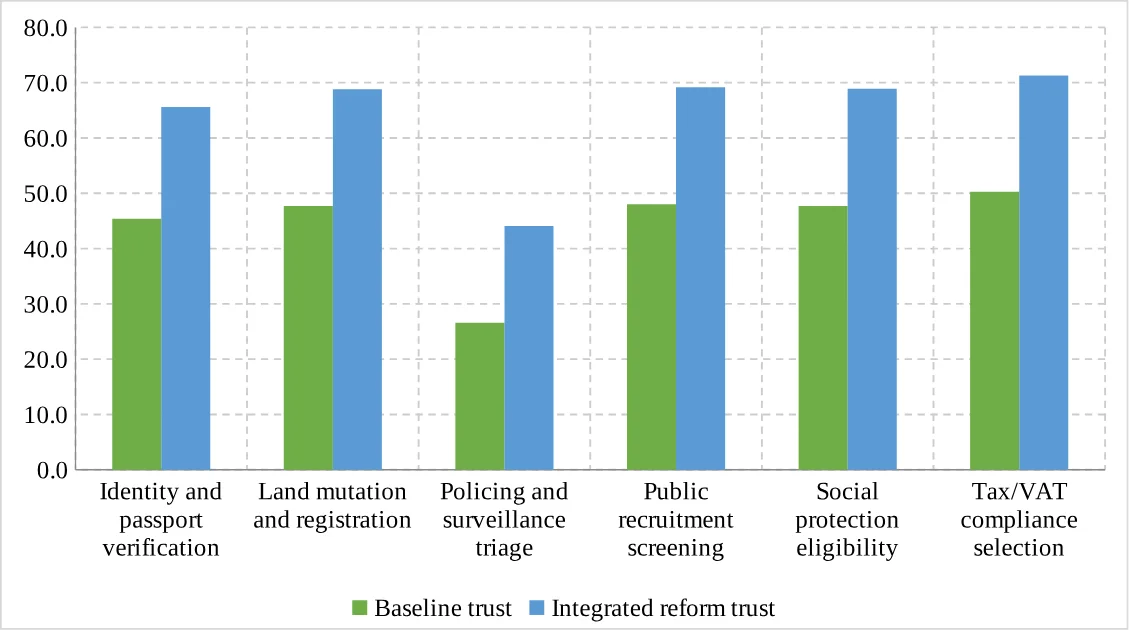
In all domains, there was an increase in trust. The selection of the tax or VAT was the only category that saw a net loss, with 21 points lost. About 21 points were lost in other categories: recruitment, social protection, land administration, and tax or VAT selection. There was an increase in identity administration of 20.2 points. Policing and surveillance rose by 17.5 points but is the least trusted domain at 44.1. Integrated reform thus brings about widespread achievement improvements without wiping out high levels of fundamental weak performance in coercive environments.
5.2 Scenario-level trust performance and system error
This subsection is the dimension for reforms-scenario. It examines the impacts of Trust and Operational Reliability when automation is accelerated, capacity is reformed, governance is reformed and integrated is reformed. The difference lies between the technical expansion and institutionally managed automation. Figure 3 shows the mean of the procedural trust for the five scenarios.
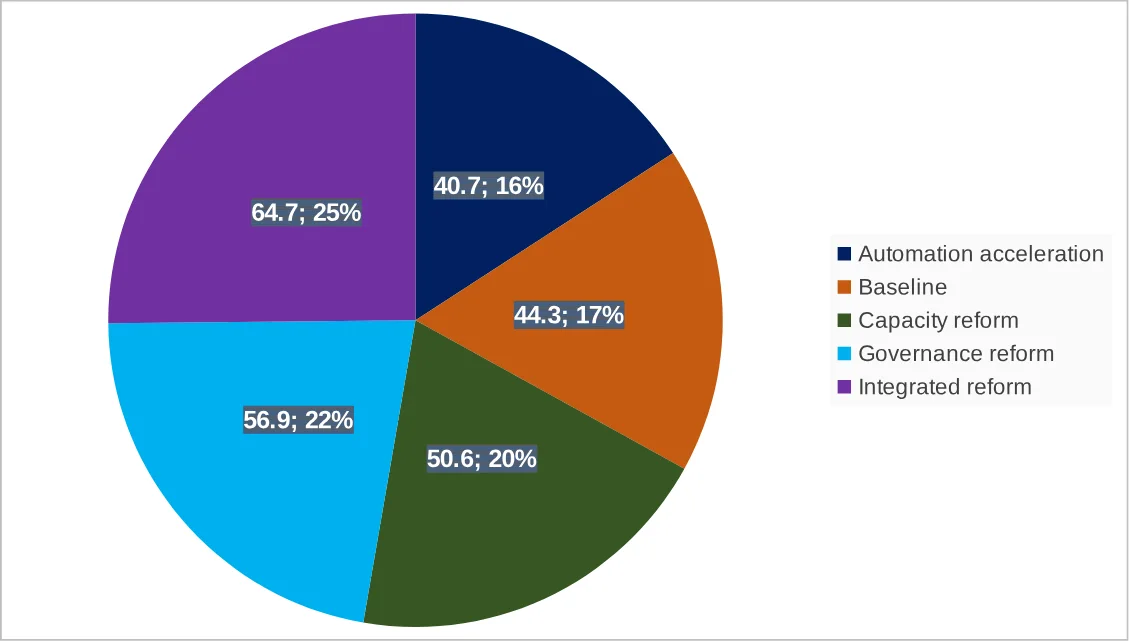
A clear reform gradient was not only identified but there was a reform gradient. The automation acceleration had the lowest trust score of 40.7, which is lower than the baseline score of 44.3. The levels of trust, governance and integrated reform were increased by capacity reform (50.6), governance reform (56.9) and integrated reform (64.7). Thus, governance reform resulted in double the direct trust gain from capacity reform and their combination resulted in the greatest gain in trust. Table 2 shows the results of the dispersion and error-resolving processes corresponding to the above.
Table 2. Scenario-level operational outcomes
| Scenario | Trust SD | Error incidence (%) | Unresolved error (%) | Resolved share of errors (%) |
|---|---|---|---|---|
| Automation acceleration | 13.81 | 31.80 | 26.42 | 16.92 |
| Baseline | 14.60 | 30.86 | 24.47 | 20.71 |
| Capacity reform | 14.56 | 25.32 | 18.25 | 27.92 |
| Governance reform | 15.16 | 30.89 | 19.45 | 37.04 |
| Integrated reform | 14.75 | 25.06 | 13.46 | 46.29 |
The percentage of errors in integrated reform was 25.1%, which was 13.5% for error not resolved and 46.3% for errors resolved. Compared to governance reform, capacity reform was able to solve a smaller proportion of errors, and resulted in an initial error rate of 25.3%. Governance reform resulted in an unchanged level of raw errors and a 37.0% increase in resolution efficiency. Capacity is used to make wrong decisions less, governance is increased to correct, and reform is done together to align both.
5.3 Contestation pathway from explanation to correction
This subsection is a procedure through which a citizen can get an explanation, file an appeal, challenge an incorrect decision and get the decision corrected. It also considers contestability as it does not make much sense to disclose a problem if it can't be reviewed or is not being reviewed effectively. Figure 4 highlights the differences between the baseline and integrated reform in four stages of the contestation pathway.
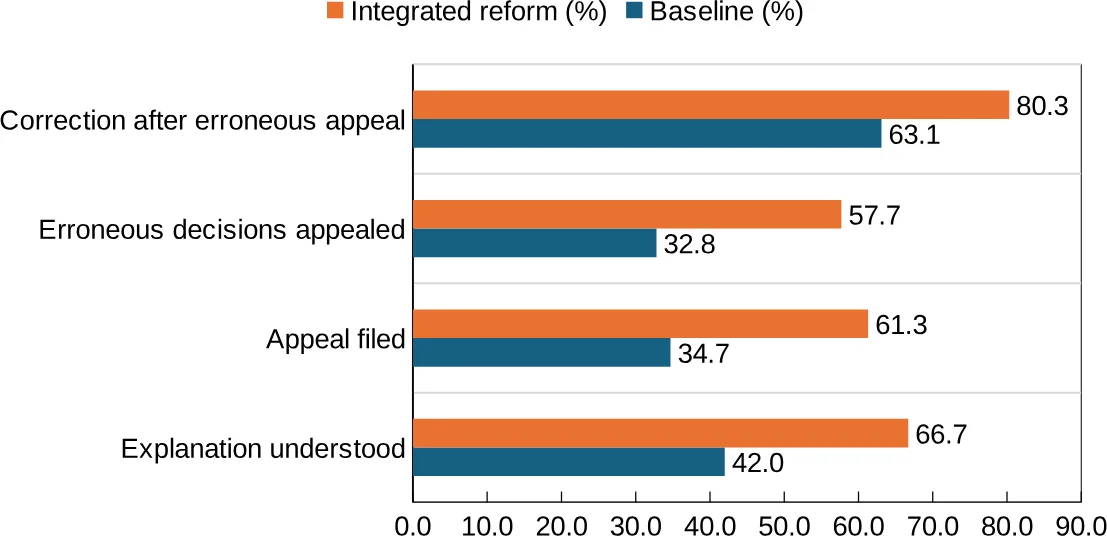
The baseline rate of understood explanations was 42.0% and appeals was 34.7%. Of the wrong decisions entered, there was an appeal rate of 32.8% and 63.1% of the appealed errors were corrected. The results of the integrated reform were explanation comprehension (66.7%), filing of appeal (61.3%), appealing an error (57.7%), and correcting (80.3%) after an error was appealed. The pathway becomes more robust at each level, with more clear explanations of the reasons, more challenging activities and more robust remedial performance.
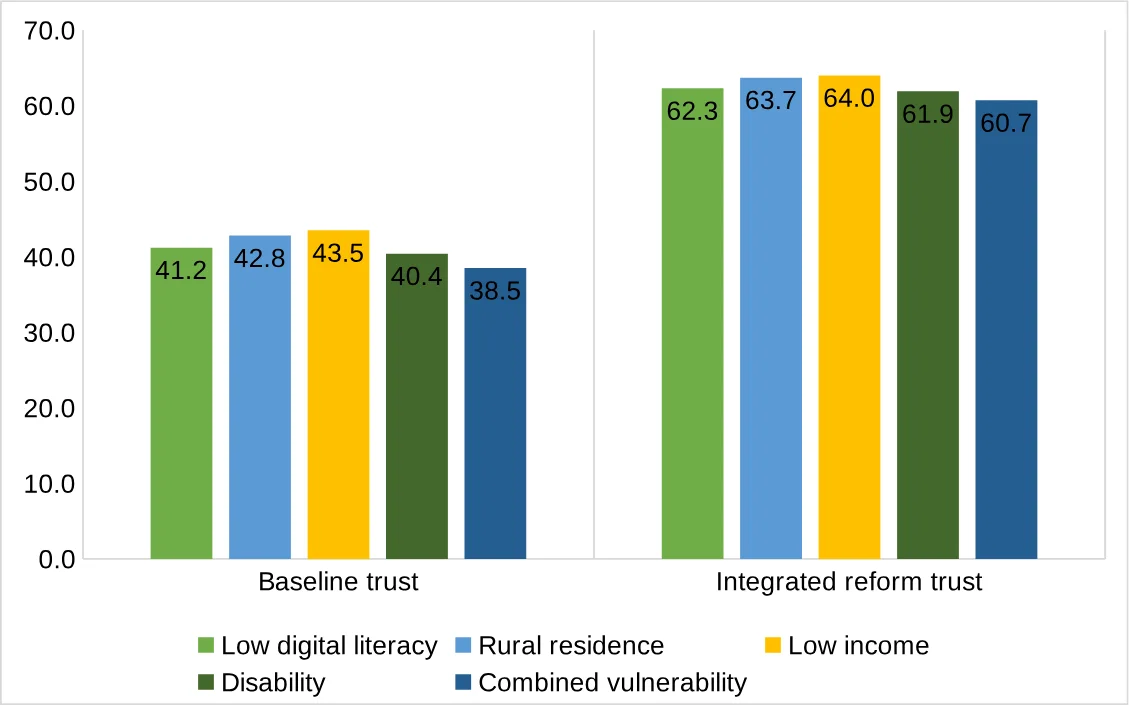
5.4 Distributional equity among groups facing access barriers
This subsection is a manifestation of the distributional aspect of contestable government. It examines the level of trust citizens with low digital literacy have in people living in rural areas, low income, disability and combined vulnerability have. The analysis is significant because even though the procedure is formally the same, there is inequality when the access to the procedure is different. The indicators of institutional and scenario are not repeated in the tables, but rather the absolute baseline and the integrated trust are reported.
All the subgroups under integrated reform scored an increase in trust points of at least 20.5. Low-income encounters were at 64.0, rural encounters were at 63.7, low literacy encounters were at 62.3 and disability-related encounters were at 61.9. The group that was most vulnerable combined to gain the most at 22.3 points, but were still the lowest-trust group at 60.7. Reform does not take away procedural disadvantage; it only reduces it, which means assistance in filing, providing local-language explanations, accessibility to information offline, and access to information that is accessible to disabled people must continue.
5.5 Multivariate drivers and governance-capacity complementarity
This subsection refers to the explanatory dimension. It examines the issue of governance, capacity, access to procedures, error correction, uncorrected error and barriers to access following simultaneous adjustment. These mechanisms are not so isolated as they can be described in comparison to other components. The adjusted coefficients and uncertainty estimates are given in Table 3.
Table 3. OLS model of procedural trust with HC3 standard errors
| Predictor | Coefficient | HC3 SE | 95% confidence interval | p-value |
|---|---|---|---|---|
| Intercept | 27.719 | 0.187 | 27.353 to 28.084 | <0.001 |
| Governance readiness | 19.658 | 0.445 | 18.785 to 20.531 | <0.001 |
| Capacity readiness | 13.737 | 0.261 | 13.226 to 14.248 | <0.001 |
| Governance x capacity | 16.221 | 0.620 | 15.005 to 17.436 | <0.001 |
| Explanation understood | 6.955 | 0.054 | 6.849 to 7.060 | <0.001 |
| Appeal filed | 5.043 | 0.059 | 4.927 to 5.158 | <0.001 |
| Appeal success | 11.009 | 0.091 | 10.831 to 11.188 | <0.001 |
| Unresolved error | -16.909 | 0.064 | -17.036 to -16.783 | <0.001 |
| Low digital literacy | -2.969 | 0.050 | -3.067 to -2.870 | <0.001 |
| Rural residence | -1.505 | 0.049 | -1.601 to -1.408 | <0.001 |
| Low income | -1.035 | 0.049 | -1.131 to -0.938 | <0.001 |
| Disability | -2.192 | 0.083 | -2.354 to -2.030 | <0.001 |
| Female | 0.122 | 0.049 | 0.025 to 0.218 | 0.013 |
87.4% of the variation in trust was accounted for by the model. Governance readiness gave 19.66 and capacity gave 13.74 points each to make up a full unit. They combined to score 16.22 points. Explanation comprehension was worth 6.95 points with appeal filing worth 5.04 points, and successful correction 11.01 points. Unresolved error had the largest negative coefficient with a drop of 16.91 points. The negative adjusted relationships were low digital literacy and disability, rural residence and low income. Figure 6 depicts the relationship between governance capacity and trust in the five governance levels and five capacity levels.
| Capacity \ Governance | 0 | 0.25 | 0.5 | 0.75 | 1 |
|---|---|---|---|---|---|
| 0 | 27.7 | 32.6 | 37.5 | 42.5 | 47.4 |
| 0.25 | 31.2 | 37.1 | 43.0 | 48.9 | 54.9 |
| 0.5 | 34.6 | 41.5 | 48.5 | 55.4 | 62.4 |
| 0.75 | 38.0 | 46.0 | 53.9 | 61.9 | 69.8 |
| 1 | 41.5 | 50.4 | 59.4 | 68.4 | 77.3 |
Figure 6: Forecasts of trust in different combinations of governance and capacity
When minimum governance and capacity was at its lowest, predicted trust increased from 27.7 to 77.3 when both are at their peak. When both capacity and governance were at full capacity, trust was 41.5 and at full governance, but zero capacity, 47.4. The joint improvement, then, yielded much more return than any of the two-dimensional improvements would have done.
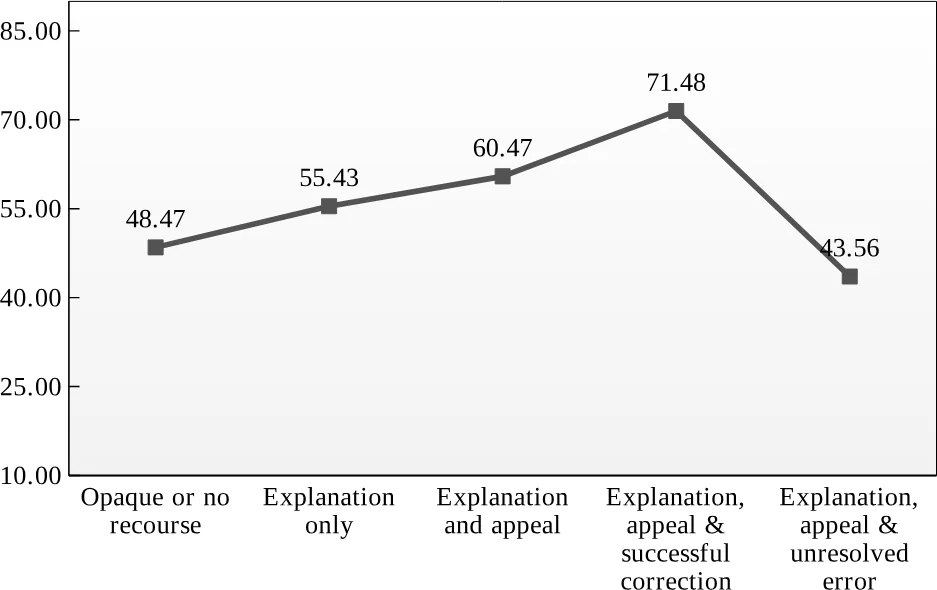
5.6 Trust under alternative procedural states and robustness
This subsection is the representation of the dimension of mechanism synthesis. It merges the concepts of explaining, appealing, correcting and non-resolved error into states of citizen facing procedural activities with governance and capacity in the middle ground. Importance of the comparison, as this is a way of showing the results of the model in terms of something that can be known in administration. The predictions obtained are shown in Figure 7.
The predicted trust was 48.5 in the case of an opaque process without recourse. Trust increased from 55.4 for explanation, to 60.5 for explanation + appeal. There was a rise of trust to 71.5 with successful correction. After explanation and appeal, trust dropped to 43.6 which was below the opaque reference state. Legitimacy, however, is reinforced when the institutions provide adequate remedy in the case of a formal challenge procedure. In all 270-alternative weighting, reform-increment and random-seed settings, integrated reform outperformed all others in terms of trust and lowest unresolved-errors profile and maintained the same order for all scenarios.
6. Discussion
The findings shift the central question from whether Bangladesh is ready to use AI toward whether its administrative system is ready to justify, review, and correct AI-influenced decisions. The governance readiness gap from the baseline and capacity readiness gap from the baseline indicate fast moving digital transformation compared to contestability. This imbalance is in line with the research on the reviewability of a decision process (Cobbe et al., 2021) where accountable automation is considered a characteristic of the entire process and not a characteristic of the model or software. Improved operational reach is provided through infrastructure, identity systems, portals and interoperable databases but it doesn't create individual reasons, easily-available appeals, independent audits or remedial authority.
The big size of the integrated-reform effect endorse the interaction mechanism of the framework. Notice, explanation, review and appeal led to better results of governance reform than capacity reform as it directly affected citizens' procedural position. The results of capacity reform were less positive when it came to trust gains, but more positive in terms of an overall drop in unresolved error, as the capacity of staff, data quality, records and workload were enhanced. When they were both combined, they had a gain that was more than either one alone. The result sheds light on why oversight by humans is frequently not met. Without competent reviewers, time and records, and authority, oversight is symbolic, and the capability of the organization without legal duties means that the only thing that can be corrected is the discretion of the organisation's members.
The contestation pathway also helps us to understand the limited policy response provided by transparency. With baseline, less than ½ of the explanations were understood, about ¼ of encounters resulted in appeals and ¼ of the encounters left an incorrect decision without being resolved. Each step made a positive improvement towards integrated reform, suggesting that trust builds over time as a result of multiple steps of the procedures. This is consistent with the experimental findings that disclosure level does not affect perceived trustworthiness; previously, it was found that level of explanation does (Grimmelikhuijsen, 2023). It also adds to that literature by identifying place for explanation within an administrative sequence, for which there are different organizational resources required for comprehension, filing, review and correction.
The variation of domains will have a significant policy impact. This was the case in the domain of policing and surveillance, which was the least trusted following the reform due to the high complexity and coercive impact of the domain, which exacerbated weak baseline safeguards. A national policy that is uniform, in other words, could thus make unequal domains equal. The thresholds for risk classification need to vary by sector, be more stringent and have more strict boundaries for coercive deployment. However, there is a different problem: strong infrastructure, low error rate, doesn't adequately help weak reasons, low appeal rights. Where people don't have access to the information or the process causing an adverse outcome, efficient identity matching only takes away from the legitimacy.
Distributional results provide a test to see if contestability is an equality issue. Trust was generally improved but low income, rural residence, low digital literacy and disability continued to have a negative impact on all sub-groups of interest. Administrative burden theory helps to understand this persistence: a formally open portal still costs the citizen learning and compliance costs that can occur if the citizen needs to rely on intermediaries, does not have a device, an interface is not accessible or heandshe has to make a trip to a local office. Therefore, these assisted channels of communication, as well as the notices in Bangla or local languages, disability-accessible formats, toll-free assistance for reviews, and local assistance locations are components of due process, not service enhancements.
The Bangladesh grievance findings provide a positive institutional comparison. While rapid forwarding and closure did not equal substantive resolution, this was because the two types of metrics were different (Khan et al., 2025). Notice counts as well as human checks or complaints on AI-governance dashboards can also be distorted. The correction rates, reasons for reversal, outcomes in subgroups, repeat errors and errors by time to final remedy need to be measured. Ultimately it is the government that is trusted not the vendor or model. Public authorities are thus responsible for the technical components and decisions on procurement that are outsourced (Bodó & Janssen, 2022).
As methodology, the study provides a clear link between the principles and consequences of the law. The simulation does not supplant field research, but does help to determine mechanisms that can be tested in future surveys, experiments, and studies using administrative data, as well as priority domains and measurable indicators. The most powerful implication of its is institutional: There is a need within Bangladesh for trusted and contestable government, where formal rights, bureaucratic capacity, and accessibility are a system. The same formulation is applicable to other administrations facing the same problem as they rapidly digitise, and which need a transferable diagnostic for their own situation.
7. Conclusion
While shifting from digital administration to an AI-influenced government, there is a legitimacy issue that can't be addressed by technology alone that needs to be addressed. This study explored the interaction between governance and administrative capacity and how they work together to protect and influence the contestability and procedural trust in six key domains of decision-making. A policy experiment was conducted using a structured institutional audit with four different scenarios: baseline, governance, capacity, integrated and automation-acceleration (60,000 encounters).
The results indicated a significant baseline imbalance that was observed as governance readiness on average was 32.3, while capacity readiness was 61.1. At baseline, trust was 44.3, but was increased to 64.7 by integrated reform and increased to 61.3% with an increase in appeal filing and decreased to 13.5% with a decrease in unresolved erroneous decisions in the integrated reform. There was a good level of positive interaction between governance and capacity. Explanation, appeal and successful correction brought a positive gain in trust while the unactioned error brought the most negative response. The advantages of living in rural areas, low digital literacy and low income and disability persisted following wide-ranging reform.
The central argument is an integrated discussion on contestability which links the fields of administrative law, organisational ability, public trust and distributive access. The model reveals the reasons behind the lack of success of transparency and human oversight as separate methods, and shows the importance of digital infrastructure. The downside is it has external validity, meaning the results are policy estimates, not observed citizen attitudes, or case records of the agencies. In future research, the linkages between administrative appeals data, citizen vignette experiments, frontline interviews, and procurement audits and subgroup fairness tests were drawn between individual agencies in Bangladesh. This would allow the refined estimated mechanisms to be directly validated and refined.
8. Recommendations
The need of the hour is to have a need to have an automated-decision (AD) system of high impact use with legal obligation of registration, individual notice, intelligible reasons, transparency in access to data, reviewable records and external appeal in public sector in Bangladesh. All deploying agencies should have a senior decision maker who is named and a multi-disciplinary review unit with legal, technical, operational and inclusion skills. The following parts of the procurement contract should be auditable, reportable, logged, data-provenance explained, vendor cooperation during appeals and records held by the State for review:
Sequencing for reform should be done in a way that incorporates rights, and capability. The deployment of the pilot should start only after the training of reviewers, assessment of workload, integration of grievances, offline filing of grievances, communication in Bangla and creation of disability-friendly format, and testing of escalation mechanisms. For coercive functions, notably policing and surveillance, more restrictions must be imposed on the scope of authority, including its independence, periodic necessity reviews, publishing of aggregate error rates and the rates of reversals. The performance dashboards should not just measure the number of complaints that pass through, but also the number of cases that are resolved, the time taken to resolve the case, the number of cases that are repeated, the cases that are resolved in sub-groups and the reasons for cases being reversed.
To ensure the success of a phased evaluation programme, a range of appeals information, citizen vignettes, frontline observation and independent algorithmic audits must be available. Social protection, land and recruitment should be prioritized during the early implementation and be recognized for their public value, as they have less coercive risk than surveillance applications, but still provide a high public value.
Author Contributions
Conceptualization, methodology, formal analysis, visualization, writing - original draft, and writing - review and editing: Asif Jawad.
Conflict of Interest
The author declares no conflict of interest.
References
- Alon-Barkat, S., & Busuioc, M. (2023). Human–AI Interactions in Public Sector Decision Making: “Automation Bias” and “Selective Adherence” to Algorithmic Advice. Journal of Public Administration Research and Theory, 33(1), 153–169. https://doi.org/10.1093/jopart/muac007
- Araujo, T., Helberger, N., Kruikemeier, S., & De Vreese, C. H. (2020). In AI we trust? Perceptions about automated decision-making by artificial intelligence. AI & SOCIETY, 35(3), 611–623. https://doi.org/10.1007/s00146-019-00931-w
- Batool, A., Zowghi, D., & Bano, M. (2025). AI governance: A systematic literature review. AI and Ethics, 5(3), 3265–3279. https://doi.org/10.1007/s43681-024-00653-w
- Baxter, D., Dacre, N., Dong, H., & Ceylan, S. (2023). Institutional challenges in agile adoption: Evidence from a public sector IT project. Government Information Quarterly, 40(4), 101858. https://doi.org/10.1016/j.giq.2023.101858
- Bodó, B., & Janssen, H. (2022). Maintaining trust in a technologized public sector. Policy and Society, 41(3), 414–429. https://doi.org/10.1093/polsoc/puac019
- Bullock, J. B. (2019). Artificial Intelligence, Discretion, and Bureaucracy. The American Review of Public Administration, 49(7), 751–761. https://doi.org/10.1177/0275074019856123
- Busuioc, M. (2021). Accountable Artificial Intelligence: Holding Algorithms to Account. Public Administration Review, 81(5), 825–836. https://doi.org/10.1111/puar.13293
- Cobbe, J., Lee, M. S. A., & Singh, J. (2021). Reviewable Automated Decision-Making: A Framework for Accountable Algorithmic Systems. Proceedings of the 2021 ACM Conference on Fairness, Accountability, and Transparency, 598–609. https://doi.org/10.1145/3442188.3445921
- Cobbe, J., & Singh, J. (2020). Reviewable Automated Decision-Making. Computer Law & Security Review, 39, 105475. https://doi.org/10.1016/j.clsr.2020.105475
- De Bruijn, H., Warnier, M., & Janssen, M. (2022). The perils and pitfalls of explainable AI: Strategies for explaining algorithmic decision-making. Government Information Quarterly, 39(2), 101666. https://doi.org/10.1016/j.giq.2021.101666
- Gordon, F. (2019). Automating Inequality: How High-Tech Tools Profile, Police, and Punish the Poor. New York: Picador, St Martin’s Press. Law, Technology and Humans, 162–164. https://doi.org/10.5204/lthj.v1i0.1386
- Green, B. (2022). The flaws of policies requiring human oversight of government algorithms. Computer Law & Security Review, 45, 105681. https://doi.org/10.1016/j.clsr.2022.105681
- Grimmelikhuijsen, S. (2023). Explaining Why the Computer Says No: Algorithmic Transparency Affects the Perceived Trustworthiness of Automated Decision‐Making. Public Administration Review, 83(2), 241–262. https://doi.org/10.1111/puar.13483
- Henman, P. (2020). Improving public services using artificial intelligence: Possibilities, pitfalls, governance. Asia Pacific Journal of Public Administration, 42(4), 209–221. https://doi.org/10.1080/23276665.2020.1816188
- Huo, R., Liu, F., & Wu, L. (2025). How does digital government influence public policy compliance in public health emergencies? —A study based on mixed method. Frontiers in Psychology, 16, 1518585. https://doi.org/10.3389/fpsyg.2025.1518585 ICT Division. (2020). National Strategy for Artificial Intelligence – Bangladesh | Digital Watch Observatory. https://dig.watch/resource/national-strategy-for-artificial-intelligence-bangladesh ICT Division. (2024). National Artificial Intelligence Policy 2024. https://regulations.ai/regulations/RAI-BD-NA-NAI2DXX-2024
- Ingrams, A., Kaufmann, W., & Jacobs, D. (2022). In AI we trust? Citizen perceptions of AI in government decision making. Policy & Internet, 14(2), 390–409. https://doi.org/10.1002/poi3.276
- Khan, M. A. S., Shawon, M. T. H., & Rabbani, A. (2025). Citizens’ feedback on health service and the responses of health authorities of Bangladesh: An analysis of the Grievance Redress System. PLOS Digital Health, 4(7), e0000967. https://doi.org/10.1371/journal.pdig.0000967
- Kuziemski, M., & Misuraca, G. (2020). AI governance in the public sector: Three tales from the frontiers of automated decision-making in democratic settings. Telecommunications Policy, 44(6), 101976. https://doi.org/10.1016/j.telpol.2020.101976
- Peeters, R., & Widlak, A. (2018). The digital cage: Administrative exclusion through information architecture – The case of the Dutch civil registry’s master data management system. Government Information Quarterly, 35(2), 175–183. https://doi.org/10.1016/j.giq.2018.02.003
- Robles, P., & Mallinson, D. J. (2025). Artificial intelligence technology, public trust, and effective governance. Review of Policy Research, 42(1), 11–28. https://doi.org/10.1111/ropr.12555
- Roehl, U. B. U., & Hansen, M. B. (2024). Automated, administrative decision‐making and good governance: Synergies, trade‐offs, and limits. Public Administration Review, 84(6), 1184–1199. https://doi.org/10.1111/puar.13799
- Roy, P. (2025). The Cyber Security Ordinance 2025: An Unofficial English Translation 1. SSRN Electronic Journal. https://www.researchgate.net/publication/398270759_The_Cyber_Security_Ordinance_2025_An_Unofficial_English_Translation_1
- Suksi, M. (2021). Administrative due process when using automated decision-making in public administration: Some notes from a Finnish perspective. Artificial Intelligence and Law, 29(1), 87–110. https://doi.org/10.1007/s10506-020-09269-x UNITED NATIONS. (2024). E-GOVERNMENT SURVEY 2024: Accelerating Digital Transformation for Sustainable Development. https://desapublications.un.org/sites/default/files/publications/2024-09/(Web%20version)%20E-Government%20Survey%202024%201392024.pdf
- Vatamanu, A. F., & Tofan, M. (2025). Integrating Artificial Intelligence into Public Administration: Challenges and Vulnerabilities. Administrative Sciences, 15(4), 149. https://doi.org/10.3390/admsci15040149
- Wirtz, B. W., Weyerer, J. C., & Sturm, B. J. (2020). The Dark Sides of Artificial Intelligence: An Integrated AI Governance Framework for Public Administration. International Journal of Public Administration, 43(9), 818–829. https://doi.org/10.1080/01900692.2020.1749851 World Bank. (2025). GovTech Maturity Index 2025: Tracking Public Sector Digital Transformation Worldwide. Washington, DC: World Bank. https://doi.org/10.1596/44136
- Young, M. M., Bullock, J. B., & Lecy, J. D. (2019). Artificial Discretion as a Tool of Governance: A Framework for Understanding the Impact of Artificial Intelligence on Public Administration. Perspectives on Public Management and Governance, gvz014. https://doi.org/10.1093/ppmgov/gvz014
- Zhang, M., & Bhattacharjee, B. (2024). Evaluating The Impact of E-Governance on Public Service Delivery: A Case Study of Bangladesh. Malaysian Journal of Social Sciences and Humanities (MJSSH), 9(9), e002960. https://doi.org/10.47405/mjssh.v9i9.2960
- Zuiderwijk, A., Chen, Y.-C., & Salem, F. (2021). Implications of the use of artificial intelligence in public governance: A systematic literature review and a research agenda. Government Information Quarterly, 38(3), 101577. https://doi.org/10.1016/j.giq.2021.101577
CITE THIS ARTICLE
Jawad, A. (2026). From Automated Decisions to Contestable Government in Bangladesh: How AI Governance and Administrative Capacity Shape Public Trust. https://www.researchbyasif.com/article/9b9c0946-4987-4c57-ab33-5f18e769bce4
A. Jawad, “From Automated Decisions to Contestable Government in Bangladesh: How AI Governance and Administrative Capacity Shape Public Trust,” 2026. [Online]. Available: https://www.researchbyasif.com/article/9b9c0946-4987-4c57-ab33-5f18e769bce4
Jawad, A. (2026) ‘From Automated Decisions to Contestable Government in Bangladesh: How AI Governance and Administrative Capacity Shape Public Trust’. Available at: https://www.researchbyasif.com/article/9b9c0946-4987-4c57-ab33-5f18e769bce4
Jawad, Asif. “From Automated Decisions to Contestable Government in Bangladesh: How AI Governance and Administrative Capacity Shape Public Trust.” 2026, https://www.researchbyasif.com/article/9b9c0946-4987-4c57-ab33-5f18e769bce4.
Asif Jawad. “From Automated Decisions to Contestable Government in Bangladesh: How AI Governance and Administrative Capacity Shape Public Trust.” (2026). https://www.researchbyasif.com/article/9b9c0946-4987-4c57-ab33-5f18e769bce4.
Jawad A. From Automated Decisions to Contestable Government in Bangladesh: How AI Governance and Administrative Capacity Shape Public Trust. 2026. https://www.researchbyasif.com/article/9b9c0946-4987-4c57-ab33-5f18e769bce4
@misc{article_9b9c094649874c57ab335f18e769bce4,
  title = {From Automated Decisions to Contestable Government in Bangladesh: How AI Governance and Administrative Capacity Shape Public Trust},
  author = {Asif Jawad},
  year = {2026},
  url = {https://www.researchbyasif.com/article/9b9c0946-4987-4c57-ab33-5f18e769bce4},
}
TY - GEN AU - Asif Jawad TI - From Automated Decisions to Contestable Government in Bangladesh: How AI Governance and Administrative Capacity Shape Public Trust PY - 2026 UR - https://www.researchbyasif.com/article/9b9c0946-4987-4c57-ab33-5f18e769bce4 ER -